Site seems to be OK. Load issue should be resolved now.
240 gr cast 44 are keyholeing at 25 yards
Re: 240 gr cast 44 are keyholeing at 25 yards
Yep,that's my plan. Thanks
-
fortyshooter

- Ranch Foreman
- Posts: 7099
- Joined: Sat Dec 09, 2017 10:37 am
- Location: Va.

Re: 240 gr cast 44 are keyholeing at 25 yards
Nope you can stick with your .430 cast bullets,,,,well the Missouri Bullets 240gr. You have to run them fast for a coated lead bullet up around 1500 FPS
Out of my carbine and they straighten out and shoot fine. Watch my latest test today in the Range forum.
Out of my carbine and they straighten out and shoot fine. Watch my latest test today in the Range forum.
Re: 240 gr cast 44 are keyholeing at 25 yards
Yep .4315. So I have a sample of .432 coming to try. That Henry shoots nowhere as good as my Rossi.
-
fortyshooter
- Ranch Foreman
- Posts: 7099
- Joined: Sat Dec 09, 2017 10:37 am
- Location: Va.
Re: 240 gr cast 44 are keyholeing at 25 yards
Yep try those .432's with same load and then the 430's at a load to get up around 1500 FPS. That worked out well for me.

Re: 240 gr cast 44 are keyholeing at 25 yards
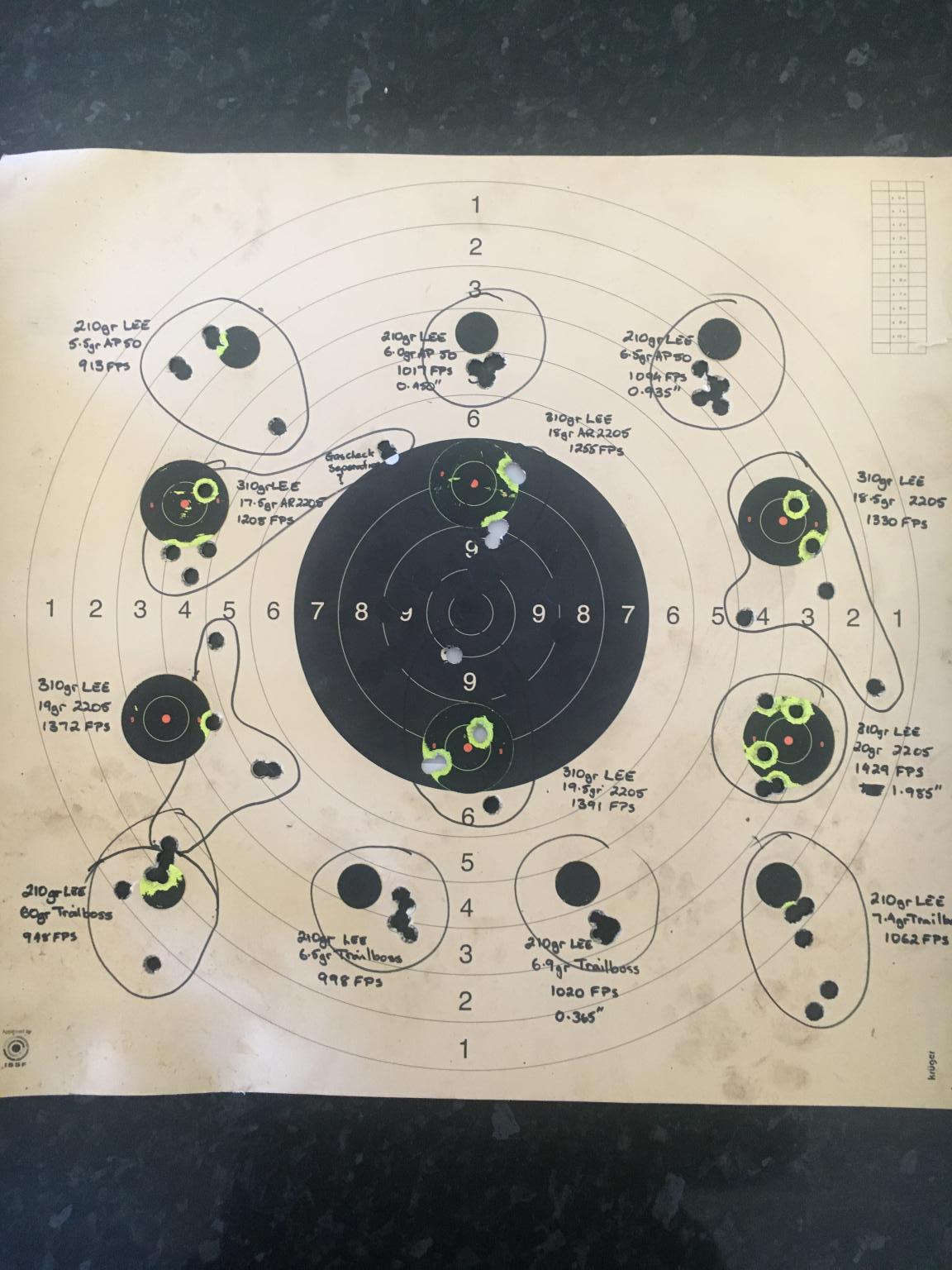
This was the target from initial load development with sons 44mag
Top row is 210gr with AP-50 a powder with a similar burn rate to trailboss but not the density shot at 25y. The middle 2 rows are 310gr shot at 50y and the bottom row 210gr again this time with trailboss.
It is amazing the difference just half a grain can make to the performance, both powders tried with the 210gr groups tightened up with increased powder charges and then opened up as it was increased further.
The heavy 310gr groups continued to improve as the powder charge was increased. What I would expect as velocity increases stability and the 310gr must be at the limit of stability in this rifle.
This is pretty much what I do when working up loads for any rifle, I will retest the loads that show promise with multiple groups at longer range and if still not satisfied with the results try even smaller powder increase or decreases and play with things like the amount of crimp etc.
If your bullets are tumbling it is because they are not stabilising you need to work out why.
Under sized bullets not engaging the rifling, this will be worse with hardcast and lower pressure loads, softer bullets will usually expand in diameter enough to full engage the rifling hard cast may do the same at higher pressures.
To soft a bullet at to high a pressure will strip in the rifling, a faster twist will exacerbate this as the bullet rotation speed is increased even at the same velocity.
Imperfections in bullets can also cause instability although usually only the odd bullet that will ruin a otherwise respectable group.
Then you have combinations that just refuse to work for no obvious reason.
Top row is 210gr with AP-50 a powder with a similar burn rate to trailboss but not the density shot at 25y. The middle 2 rows are 310gr shot at 50y and the bottom row 210gr again this time with trailboss.
It is amazing the difference just half a grain can make to the performance, both powders tried with the 210gr groups tightened up with increased powder charges and then opened up as it was increased further.
The heavy 310gr groups continued to improve as the powder charge was increased. What I would expect as velocity increases stability and the 310gr must be at the limit of stability in this rifle.
This is pretty much what I do when working up loads for any rifle, I will retest the loads that show promise with multiple groups at longer range and if still not satisfied with the results try even smaller powder increase or decreases and play with things like the amount of crimp etc.
If your bullets are tumbling it is because they are not stabilising you need to work out why.
Under sized bullets not engaging the rifling, this will be worse with hardcast and lower pressure loads, softer bullets will usually expand in diameter enough to full engage the rifling hard cast may do the same at higher pressures.
To soft a bullet at to high a pressure will strip in the rifling, a faster twist will exacerbate this as the bullet rotation speed is increased even at the same velocity.
Imperfections in bullets can also cause instability although usually only the odd bullet that will ruin a otherwise respectable group.
Then you have combinations that just refuse to work for no obvious reason.