Page 1 of 3
Reloading newbie stupid question.
Posted: Mon Nov 18, 2019 8:12 pm
by Albertaktm
I have bought all the equipment from reloading and projectiles and powder for my 45-70 and 6.5 Creedmoor. I am now looking at brass powder and projectiles for my new Henry 44. My question is, when I find a projectile that I am going to buy, I look at the load data to find the powder I now should buy. For a 200 grain round, the powders available go from 8-26 grains in the minimum load. Just a rough example. So in the interest of being cheap, why would I buy a powder that requires 3X as much to get the same FPS speed? My unskilled loading brain says buy a powder that only requires roughly 10 grains and I'll get 3X more loaded rounds than if I select a powder that requires 27 plus grains.
Except for my 6.5 CM, I'm not into shooting super super close groups. Any help would be appreciated!
Re: Reloading newbie stupid question.
Posted: Mon Nov 18, 2019 10:10 pm
by fortyshooter
The amount of powder used is based on the burn rate vs. pressure limits to attain a certain speed.
Usually a slower burning powder will enable you to reach a higher FPS while staying within the pressure limits of a particular gun.
However for milder loads some slow burning powders don't work well at reduced levels where a smaller amount of a faster burning powder will work well.
For .44 Magnum Unique powder works well for starting and mid range loads like a 200 or 240 gr. bullet at 9 to 11 grs.
Alliant 2400 powder works better for higher range loads while staying within pressure limits.
For my plinking .44 mag loads I like 9 grs. Unique with a 240 gr. powder coated bullet like the Missouri Bullet.

Oh and welcome to the forum from Central Va.!
Re: Reloading newbie stupid question.
Posted: Mon Nov 18, 2019 10:17 pm
by JEBar
as a general rule, I agree with giving the powder that allows you to generate the speed you want with the lowest volume of powder a try .... for me it usually works .... other powder concerns are availability and cost .... just as a point to consider, the barrel twist in a Henry is designed to stabilize 240 gr bullets .... that isn't to say it can't / won't shoot smaller or larger bullets .... we tried several different bullet weights and shapes .... in the end we settled on 240 JHP's .... as to brass, we use Starline
https://www.starlinebrass.com/ .... its the best we have found for price and quality
Re: Reloading newbie stupid question.
Posted: Mon Nov 18, 2019 11:12 pm
by wingnut
From a safety standpoint...
I generally look for a powder that will fill a pistol case at least half full for the particular bullet & desired speed. Then, you can immediately see if you have "thrown" a double charge of powder in it before applying the bullet. Saves a very, very bad day.

Re: Reloading newbie stupid question.
Posted: Tue Nov 19, 2019 9:19 am
by Ojaileveraction
Not a stupid question at all.
It is one, I think, every reloader has at one time or another.
What are your needs and wants?
I reload for the specific purpose of shooting Silhouette.
I only load for my rifles. I like to shoot low to moderate pressures loads. When I get a new cartridged to load for, I want a powder that will fill the case as much as possible.
At the pressure I like to shoot, low to moderate depending on the cartridge, the faster powders can be , in my experience (opinion) , position sensitive.
Many others use pistol powders and do well with them.
I fell I made a consider effort with the pistol powders but I didn't get what I wanted out of them.
Re: Reloading newbie stupid question.
Posted: Tue Nov 19, 2019 10:33 am
by runnin n gunnin
JEBar wrote: ↑Mon Nov 18, 2019 10:17 pm
as a general rule, I agree with giving the powder that allows you to generate the speed you want with the lowest volume of powder a try .... for me it usually works .... other powder concerns are availability and cost .... just as a point to consider, t
he barrel twist in a Henry is designed to stabilize 240 gr bullets .
... that isn't to say it can't / won't shoot smaller or larger bullets .... we tried several different bullet weights and shapes .... in the end we settled on 240 JHP's .... as to brass, we use Starline
https://www.starlinebrass.com/ .... its the best we have found for price and quality
JEBar, quick question. You stated the Henry's twist is designed to stabilize a 240 grain bullet. Are you talking about the .44 specific?
That being said, do you now if the Henry design is bullet weight specific for other calibers. I shoot 45 colt and 357. I use a 225 grain bullet for the 45 both in JHP and lead, and do the same for the .357 using 158 grain which I also use in my pistols. I have had great performance so far with both.
I realize that barrel twist rate can limit bullet weight for various shoulder weapons, I was just curious if you had specific info from Henry as to what they specifically designed the rifle for best performance.
I haven't tried the 240s yet, but it looks like I may have to give it a try. Thanks for the info JEBar !
Re: Reloading newbie stupid question.
Posted: Tue Nov 19, 2019 12:13 pm
by Albertaktm
A very common response I'm seeing is to select a powder that fills the cartridge as much as possible. Or at least select a load size that fills it at least 50% so you can tell if it gets a double charge before you seat a bullet.
How can you tell this BEFORE you buy a powder listed on the load data? Knowing that weight and volume are not linear. (Lb of rocks vs Lb of feathers)
I have a Lee Auto Drum powder measure. How would this double charge a shell?
Questions questions!
Re: Reloading newbie stupid question.
Posted: Tue Nov 19, 2019 12:30 pm
by Ojaileveraction
How can you tell this BEFORE you buy a ... thers)
Some companies list fill as a pecentage. Nothing like expierience thou.
You'll need to proof all this advice and see if it stands true with your setup.
Reloading is a science in that you make an assumption, test it to see if it is true and repeatable. Then repeat.
Re: Reloading newbie stupid question.
Posted: Tue Nov 19, 2019 12:51 pm
by Shakey Jake
I have tried different powders for each caliber to fine out what my particular rifle/pistol and shooting environment likes. As an example, last weekend I took out my 25-06 and used Reloader 17; Reloader 22, and IMR 4350 with 115 gr Nosler partition bullets. I think I loaded 15 ea. Anyway I found out that my Ruger No. 1 rifle liked the IMR 4350 best. About a month ago I took out the Winchester .357 and used True Blue, Accurate No 9, H110 and 2400. I found out that the 2400 and H110 were pretty much equal and did much better than the No. 9 and True Blue using a Nosler 158 gr bullet. Having said that, the True Blue groups the best in my Henry .327 using 90 gr Sierra Sportsmasters. It's not cheap to experiment but I think worth it in the long run if you want accuracy. The .243 Winchester likes Reloader 17 and the .280 Remington likes Reloader 22. Right now in my powder cabinet I have Bullesye, Power Pistol, Accuarate No 9, H110, 2400, H110, IMR 4350, Reloader 17, and Reloader 22. I use a RCBS Little Dandy measure and dies for pistol calibers. It's fast and accurate to .02gr. I measure each rifle cartridge load with my RCBS balance scale which takes time but worth it in my opinion. I've not used the Lee so I can't answer.
Re: Reloading newbie stupid question.
Posted: Tue Nov 19, 2019 1:58 pm
by Rifletom
As fortyshooter states above, and especially for someone starting out, for your .44, Unique and 2400 would be your best bet for simplicity in loading. Two forgiving powders and both will work well in your .44.
Jake, did you see my response to your 25-06 shooting?
Sorry for slight hi-jack.
Re: Reloading newbie stupid question.
Posted: Tue Nov 19, 2019 2:21 pm
by JEBar
runnin n gunnin wrote: ↑Tue Nov 19, 2019 10:33 am
JEBar, quick question. You stated the Henry's twist is designed to stabilize a 240 grain bullet. Are you talking about the .44 specific?
That being said, do you now if the Henry design is bullet weight specific for other calibers. I shoot 45 colt and 357. I use a 225 grain bullet for the 45 both in JHP and lead, and do the same for the .357 using 158 grain which I also use in my pistols.
yes, 240 gr for 44 Mag .... it is my understanding that for 357 it is 158 gr. .... that doesn't mean they can't fire other weights, that what the twist is optimized for .... no clue on 45, I don't have one .... nor have I ever loaded for that caliber
Re: Reloading newbie stupid question.
Posted: Tue Nov 19, 2019 3:22 pm
by Ojaileveraction
Don't get too twisted over twist rates.
Re: Reloading newbie stupid question.
Posted: Tue Nov 19, 2019 3:25 pm
by BruniX
hello,
the only stupid question is the one we did not dare to ask, i think.
i'm also newbie reloader.
Saturday it will be the firts day (after a year of waiting !!!) I will finally be able to test my reloads and shoot in good conditions

Many people here are very knowledgeable and will be able to give you valuable information, especially on mistakes to avoid.
personally, I read a lot of books on the subject, malfati, Lyman (love it), lee modern reloading
and ask people when i have a doubt.
i hope that can help you:
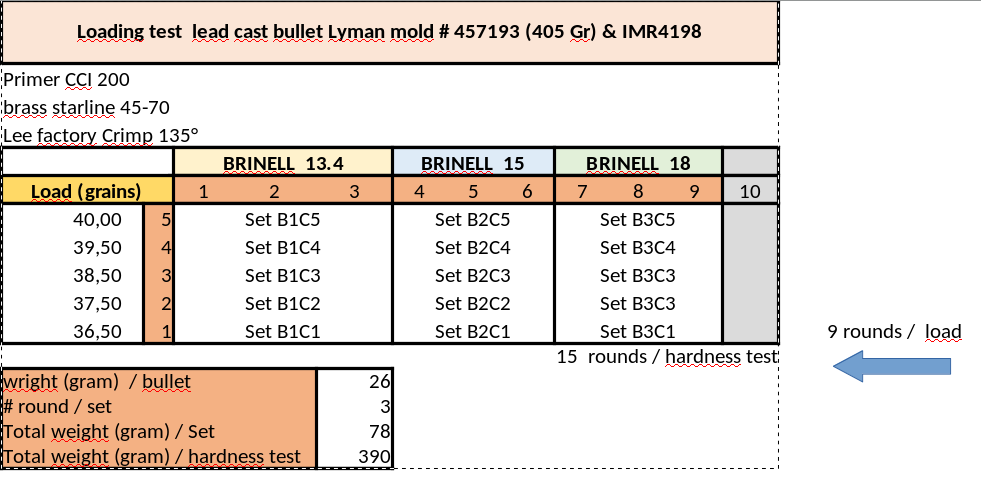
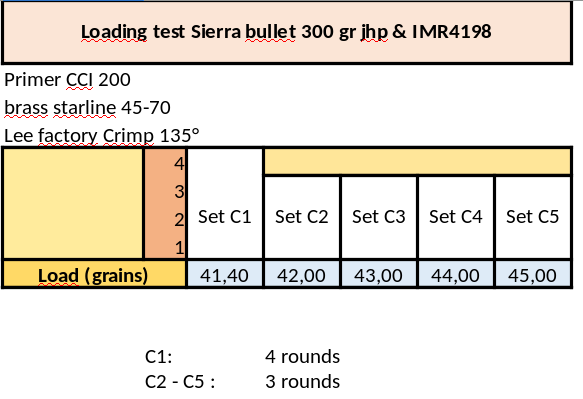
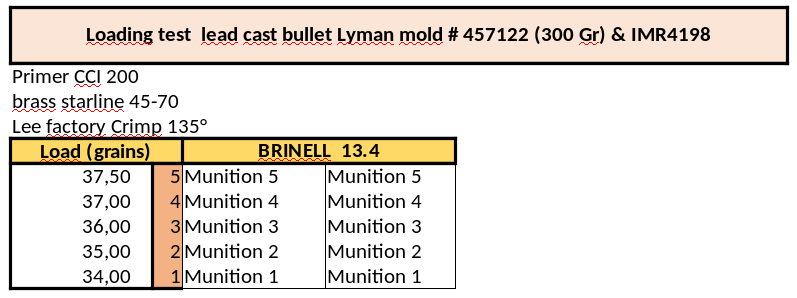
Personally for the 45-70, I make test tables based on the type of bullet cast, their hardness, the powder charge.
by comparing the results, I can then produce what suits me best.
The initial choices were based on availability (we do not find all the powders in France),
the desire to mold bullets by economy and also pleasure.
i always stay under the max load indicated on books to be sure that it is not dangerous.
after each shoot i will look at the brass to see all signs of overpressure.
405 Gr Lead bullet
- table1.png (80.88 KiB) Viewed 3341 times
sierra bullet jacketed hollow point
- table2.png (33.44 KiB) Viewed 3341 times
300 Gr Lead bullet
- table3.png (39.96 KiB) Viewed 3341 times
All the data comes from Lyman, lee & so on...
you may be able to adapt this technique to your ammunition
friendly,
bruniX
Re: Reloading newbie stupid question.
Posted: Tue Nov 19, 2019 4:51 pm
by 220
While the fps may be the same pressures can be very different. Accuracy with cast in particular can be very susceptible to peak pressure and the pressure curve.
When I was developing a load to duplicate black powder velocities in 45/70 I had already decided on the bullet. (my own cast) Accuracy with the first powder was unacceptable struggled to do better than 4" at 50y, a change of powder to a slower powder that gave the same velocity saw groups shrink to 1-2".
Every firearm is a law unto itself what works well in one may not in another identical firearm. If you are set on a certain projectile then it is a matter of trying different powders until you get acceptable accuracy. If you are set on using a particular powder then you have to live with the results or change projectiles.
Re: Reloading newbie stupid question.
Posted: Tue Nov 19, 2019 5:10 pm
by runnin n gunnin
BruniX wrote: ↑Tue Nov 19, 2019 3:25 pm
hello,
the only stupid question is the one we did not dare to ask, i think.
i'm also newbie reloader.
Saturday it will be the firts day (after a year of waiting !!!) I will finally be able to test my reloads and shoot in good conditions
Many people here are very knowledgeable and will be able to give you valuable information, especially on mistakes to avoid.
personally, I read a lot of books on the subject, malfati, Lyman (love it), lee modern reloading
and ask people when i have a doubt.
i hope that can help you:
Personally for the 45-70, I make test tables based on the type of bullet cast, their hardness, the powder charge.
by comparing the results, I can then produce what suits me best.
The initial choices were based on availability (we do not find all the powders in France),
the desire to mold bullets by economy and also pleasure.
i always stay under the max load indicated on books to be sure that it is not dangerous.
after each shoot i will look at the brass to see all signs of overpressure.
405 Gr Lead bullet
table1.png
sierra bullet jacketed hollow point
table2.png
300 Gr Lead bullet
table3.png
All the data comes from Lyman, lee & so on...
you may be able to adapt this technique to your ammunition
friendly,
bruniX
Great spread sheet BrunniX ! Its the only way I can track my loads and proficiency.
Re: Reloading newbie stupid question.
Posted: Wed Nov 20, 2019 10:42 am
by Albertaktm
Lee factory crimp 135 degrees?? I was just going over the Factory Crimp Die required or not thread in another forum. I bought a Lee 3 die .44 Mag set on the weekend. It's says right in the instructions that the optional FCD is not nessasary as the bullet seating die does the crimp. The thread then goes on about guys reloading for 40 years never use the FCD. So clearly BruniX uses it. So....what does the 135 degree mean? How is this done or set vs say 145 degree? Questions!!!
Re: Reloading newbie stupid question.
Posted: Wed Nov 20, 2019 11:18 am
by Mistered
what does the 135 degree mean? How is this done or set vs say 145 degree? Questions!!!
I think there are some misconceptions here.
There is no provision to 'set' a degree of angle for a crimp.
A standard roll crimp is determined by load, appearance and bullet style.
A collet style FCD is different in that it 'squeezes' the case mouth around the bullet and slightly tapers the rim into the bullet.
A collet style crimp die has a maximum crimping action as the collet jaws will ultimately close against one another (sort of like a drill chuck) but that would result in an excessive crimp and reduce bullet diameter but that is another issue.
It's says right in the instructions that the optional FCD is not nessasary as the bullet seating die does the crimp.
It's not necessary but the advantages and efficiency of a collet style FCD die outweigh that of the typical roll crimp with the seating die.
After many years of roll crimping I went to collet style crimp dies for .30-30 and .357 - and will never return to roll crimping.The advantages with collet die crimping is no chance of case crush due to differences in case length (especially with straight wall pistol cases) and even when trimmed evenly there is a chance of case crush with .30-30 due to the relatively thin and long case neck.
Collet crimp dies eliminate this.
Re: Reloading newbie stupid question.
Posted: Wed Nov 20, 2019 12:01 pm
by runnin n gunnin
Mistered wrote: ↑Wed Nov 20, 2019 11:18 am
what does the 135 degree mean? How is this done or set vs say 145 degree? Questions!!!
I think there are some misconceptions here.
There is no provision to 'set' a degree of angle for a crimp.
A standard roll crimp is determined by load, appearance and bullet style.
A collet style FCD is different in that it 'squeezes' the case mouth around the bullet and slightly tapers the rim into the bullet.
A collet style crimp die has a maximum crimping action as the collet jaws will ultimately close against one another (sort of like a drill chuck) but that would result in an excessive crimp and reduce bullet diameter but that is another issue.
It's says right in the instructions that the optional FCD is not nessasary as the bullet seating die does the crimp.
It's not necessary but the advantages and efficiency of a collet style FCD die outweigh that of the typical roll crimp with the seating die.
After many years of roll crimping I went to collet style crimp dies for .30-30 and .357 - and will never return to roll crimping.The advantages with collet die crimping is no chance of case crush due to differences in case length (especially with straight wall pistol cases) and even when trimmed evenly there is a chance of case crush with .30-30 due to the relatively thin and long case neck.
Collet crimp dies eliminate this.
Agreed Mistered, I also have transitioned from the roll crimp to collect style crimp.
Re: Reloading newbie stupid question.
Posted: Wed Nov 20, 2019 1:52 pm
by BruniX
hello,
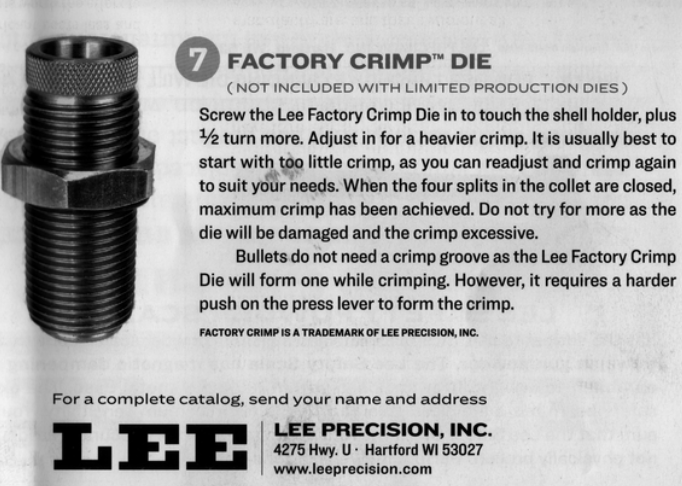
135 ° is just a way to remember the number of turns I used to set the lee factory crimp for crimping Sierra bullet:
i don't kow if the translation is correct
Bring the tool to touch the shell holder
Lock the nut
Bring the crimping adjustment screw into contact with the bullet
go down the ram
and after:
90 ° = a quarter of a turn
180 ° = 1 half turn
135 ° = middle of 1/4 and 1/2 turn
- lfc die.png (319.97 KiB) Viewed 3291 times
BruniX
Re: Reloading newbie stupid question.
Posted: Wed Nov 20, 2019 2:01 pm
by Shakey Jake
I don't crimp bullets rifle bullets that don't have a cannulure as I don't believe it's necessary. I do crimp those that do have a cannulure. I guess most anything in reloading is subjective. My motto has always been, "Do what works for you."
Jake