Page 1 of 1
USAF F-35 crash in Alaska
Posted: Wed Jan 29, 2025 7:44 am
by GunnyGene
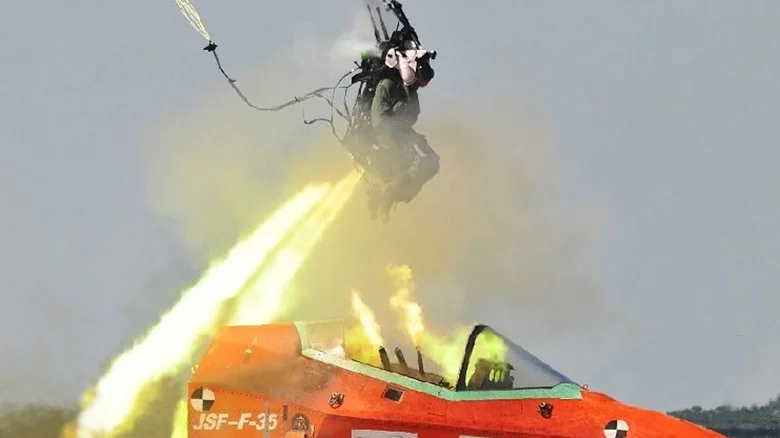
Pilot ejected safely. Looks like a flame out in the video. Good the pilot got out early. Wheels were down, that means he was low and slow when it all went sideways. He had about 2 seconds to get out.
https://www.nbcnews.com/now/video/video ... 0550597816
Re: USAF F-35 crash in Alaska
Posted: Wed Jan 29, 2025 8:55 am
by cooperhawk
Looks like a flat spin. Loss of power at low speed all dirtied up for landing.
Not much time to evaluate the situation. Just get your butt out.

Re: USAF F-35 crash in Alaska
Posted: Wed Jan 29, 2025 8:59 am
by Sir Henry
I’ve heard ejecting like that compresses your spine ending your flying career.
Re: USAF F-35 crash in Alaska
Posted: Wed Jan 29, 2025 9:03 am
by GunnyGene
cooperhawk wrote: ↑Wed Jan 29, 2025 8:55 am
Looks like a flat spin. Loss of power at low speed all dirtied up for landing.
Not much time to evaluate the situation. Just get your butt out.
Yep. Right at the start of the video, it looks like he was at around 1000' or less agl when he ejected. I'm sure the details will be forthcoming in the next day or 2.
Re: USAF F-35 crash in Alaska
Posted: Wed Jan 29, 2025 1:17 pm
by Vaquero
Gene, off subject, but the daughter and sil, he's AF, they have some close friends there. He's in ammo same as the sil.
Was going to ask him this morning if he heard anything, but he left before I had a chance to talk to him.
RP
Re: USAF F-35 crash in Alaska
Posted: Wed Jan 29, 2025 2:09 pm
by GunnyGene
Sir Henry wrote: ↑Wed Jan 29, 2025 8:59 am
I’ve heard ejecting like that compresses your spine ending your flying career.
Not necessarily. I know 3 pilots who successfully ejected without any injuries and were cleared for flying within a week. It depends mostly on if your back is straight or not, and ejection seats have an automatic retraction of the harness to pull you upright if you're hunched over. Also, G forces has been reduced to around 13 G or a little less in the last 50 years from up around 18 G in the early days, so not as much strain on the pilot. It's still quite a kick in the butt, and many other factors are involved in a ejection, such as aircraft attitude, altitude, speed, pilot weight, sink rate, degree of control of the aircraft, etc. especially at low altitudes.
Re: USAF F-35 crash in Alaska
Posted: Thu Jan 30, 2025 9:12 am
by Hatchdog
With last nights mid air crash between the Army’s Blackhawk and the commercial jet it sure has been a tough week for our military’s aviation.

Re: USAF F-35 crash in Alaska
Posted: Thu Jan 30, 2025 10:14 am
by GunnyGene
Hatchdog wrote: ↑Thu Jan 30, 2025 9:12 am
With last nights mid air crash between the Army’s Blackhawk and the commercial jet it sure has been a tough week for our military’s aviation.
Having been involved in aviation in various capacities for about 35 years prior to my retirement from the USMC and Boeing, I've noticed that incidents such as this seem to happen in clusters for no discernible reason.
*******************************
Just to add to my previous about the F-35 ejection, y'all may not know that some military aircraft egress systems will eject thru the canopy plexiglass, and some require the canopy to be jettisoned prior to the seat being ejected which involves an interlock mechanism. The old A-4 Sky Hawk was one of the later types.
The B-52 egress systems for the crew is interesting. 2 crew members would be ejected downward due to the location of those crew members position in the crew compartment. Not conducive to a successful ejection at low altitudes such as takeoff or landing.
https://ejectionsite.com/b-52.htm
Navigator and radar navigator escape hatches. In figure 1, you see that the navigator and radar navigator escape hatches are located directly below the downward ejection seats. The hatches (fig. 4) are closed normally; their main purpose is to provide an opening for the downward ejection seats during an emergency. An emergency escape hatch jettison handle, which is located in the forward inboard corner of the escape hatch well, provides an alternate means of jettisoning the escape hatch for bailout if the normal system fails to operate. When jettisoning takes place, gas pressure from the arming initiator fires the hatch jettison thruster. Gas expansion in the thruster causes the thruster shaft to extend. The thruster shaft is connected to the torque tube by a thruster extension and the actuator arm (fig. 5). One side of the thruster extension contacts a lug on the lock cam. The thruster extension is slotted so that as the thruster shaft. extends, the thruster extension first rotates the lock cam. When the lock cam has rotated far enough to unlock the mechanism, the thruster extension picks up the pin through the actuator arm causing it to rotate. A lug on the actuator arm bears against the lock arm causing the torque tubes to rotate and open the forward end of the hatch into the slipstream where the hatch is carried free of the aircraft. A hydraulic damper is incorporated in the mechanism in such a manner that the shock produced by the thruster is reduced. Also, a lifter mechanism assists in jettisoning the hatch when the hatch jettison thruster is fired. The jettison assist straps stop the lifter after it has swung approximately 25° away from the hatch.
Also, here's what happens during an ejection from an F-35
https://www.slashgear.com/1702210/what- ... et-unique/
Re: USAF F-35 crash in Alaska
Posted: Thu Jan 30, 2025 10:54 am
by cooperhawk
In about 1978 I was a guest on a B52 mission out of Seymour Johnson AFB in North Carolina. Soon after take off we had smoke in the cockpit from an electrical fire. Everyone seem quite calm as they handled the situation, except myself of course.
I came on the intercom and said, "Excuse me captain, I noticed that everyone on board is in an ejections seat but me. What do I do if we have to get out?"
His reply was, " Aww, don't worry about it. If we have to get out I'll zoom the AC to lose speed and then just pick a hole. There will be six to chose from."
Re: USAF F-35 crash in Alaska
Posted: Thu Jan 30, 2025 1:50 pm
by Bake
GunnyGene wrote: ↑Wed Jan 29, 2025 2:09 pm
Sir Henry wrote: ↑Wed Jan 29, 2025 8:59 am
I’ve heard ejecting like that compresses your spine ending your flying career.
Not necessarily. I know 3 pilots who successfully ejected without any injuries and were cleared for flying within a week. It depends mostly on if your back is straight or not, and ejection seats have an automatic retraction of the harness to pull you upright if you're hunched over. Also, G forces has been reduced to around 13 G or a little less in the last 50 years from up around 18 G in the early days, so not as much strain on the pilot. It's still quite a kick in the butt, and many other factors are involved in a ejection, such as aircraft attitude, altitude, speed, pilot weight, sink rate, degree of control of the aircraft, etc. especially at low altitudes.
I retired in '83, back then the success rate was about 70% to return to flight status. I worked for a Lt.Col. who punched out over Hanoi and after 7 years at the Hilton, he was a mess. . . 