Today's selection comes from the TSHA web portal. A lot of people have heard of the "Yellow Rose" of Texas, the Mulato woman that kept Santa Ana "busy" during the battle of San Jacinto, but not too many have heard of Sarah Bowman outside of Texas. She was a large woman standing at 6'2". This is a long read but some of you will find it interesting:
Sarah Bowman, commonly known as the Great Western or the Heroine of Fort Brown, legendary camp follower of the Mexican War, hotelkeeper, and sometime prostitute, was born Sarah Knight in 1812 or 1813, but whether in Tennessee or Clay County, Missouri, is unclear. She acquired several husbands during the course of her travels, many without benefit of clergy, so there is considerable confusion about her surname. In various sources and at different times she is referred to as Mrs. Bourjette, Bourget, Bourdette, Davis, Bowman, Bowman-Phillips, Borginnis, and possibly Foyle. A mountain of a woman who stood six feet two inches tall, she picked up the nickname Great Western, probably in a reference to the contemporary steamship of that name, which was noted for its size. John Salmon Ford wrote that she "had the reputation of being something of the roughest fighter on the Rio Grande and was approached in a polite, if not humble, manner." Little is known about Sarah before the Mexican War. Rumors claim that she was with Zachary Taylor's forces during the Seminole Wars, but her first substantiated appearance occurred in 1845, when she accompanied her husband, a soldier in the Eighth United States Infantry and a member of Taylor's army of occupation, to Corpus Christi. At that time the wives of enlisted men could enroll with the army as cooks and laundresses and follow their husbands into the field. Among these camp followers was the Great Western, who cooked for appreciative officers. Sarah first distinguished herself as a fighter at the crossing of the Arroyo Colorado in March 1846, when she offered to wade the river and whip the enemy singlehandedly if Gen. William Jenkins Worth would lend her a stout pair of tongs. The legends surrounding her exploits grew during the bombardment of Fort Brown in May 1846, when she refused to join the other women in an underground magazine but calmly operated her officers' mess uninterrupted for almost a week, despite the fact that a tray was shot from her hands and a stray shell fragment pierced her sunbonnet. Her fearlessness during the siege earned her another nickname, the Heroine of Fort Brown. She traveled with the army into the interior of Mexico and opened a hotel in Saltillo, the American House, where she again demonstrated her bravery during the battle of Buena Vista by loading cartridges and even carrying some wounded soldiers from the battlefield to safety. During this period she was married to her second husband, known variously as Bourjette, Bourget, and Bourdette, a member of the Fifth Infantry. Sarah apparently remained in Saltillo as a hotelkeeper until the end of the war, but in July 1848 she asked to join a column of dragoons that had been ordered to California. By this time her husband was probably dead, and she was told that only married women could march with the army. Undaunted, she rode along the line of men asking, "Who wants a wife with fifteen thousand dollars and the biggest leg in Mexico? Come, my beauties, don't all speak at once. Who is the lucky man?" After some hesitation a dragoon named Davis, probably David E. Davis, stepped forward, and the Great Western once again marched with the army.
In 1849 Sarah arrived in El Paso and briefly established a hotel that catered to the flood of Forty-niners traveling to the gold fields. She leased the hotel to the army when she left for Socorro, New Mexico, with a new husband, Albert J. Bowman, an upholsterer from Germany. When Bowman was discharged on November 30, 1852, the couple moved to Fort Yuma, where Sarah opened another restaurant. She lived first on the American, then the Mexican, side of the river, to protect her adopted children. By the mid-1860s she was no longer married to Bowman, but she served as company laundress and received an army ration. In 1856 she traveled to Fort Buchanan to set up a hotel ten miles below the fort. She had returned to Fort Yuma by 1861. Although Sarah was well known as a hotelkeeper and restaurateur, she probably had other business interests as well. One chronicler referred to her as "the greatest whore in the West," and Lt. Sylvester Mowry, a soldier stationed at Fort Yuma in 1856, wrote of Sarah that "among her other good qualities she is an admirable `pimp'." The date of Sarah's death, reportedly caused by a tarantula bite, is unclear, though one contemporary source indicates that she died in 1863. She was buried in the Fort Yuma post cemetery on December 23, 1866, with full military honors. In August 1890 the Quartermaster's Department of the United States Army exhumed the 159 bodies buried at the Fort Yuma cemetery and moved them to the presidio at San Francisco, California. Among these bodies was that of Sarah Bowman.
Site seems to be OK. Load issue should be resolved now.
Traces of Tx (today)
-
Shakey Jake
- Drover
- Posts: 4351
- Joined: Wed Aug 16, 2017 11:10 am
- Location: Sugar Land, TX
- Contact:

Re: Traces of Tx (today)
- Attachments
-
- Bowman marker.jpg (27.27 KiB) Viewed 939 times
-
Shakey Jake
- Drover
- Posts: 4351
- Joined: Wed Aug 16, 2017 11:10 am
- Location: Sugar Land, TX
- Contact:
Re: Traces of Tx (today)
This mornings entry also comes from the TSHA web portal:
On this day in 1886, one of the biggest gun battles in the history of the American West broke out on the day after a city election in Laredo. In 1884 two political factions in Laredo and Webb counties designated themselves as Botas and Guaraches. The Botas ("Boots"), led by Raymond Martin and José María Rodríguez, were essentially the "wealthy" class, although they drew much support from the less fortunate. The reform club, which adopted the slogan Guaraches ("Sandals") to symbolize the lower class, included Santos Benavides and, later, Darío Gonzales. In the city election of 1886, the Guaraches won only two seats on the Laredo city council. In their celebration the following day, the Botas paraded the streets of Laredo promising to bury a Guarache in effigy. After the Guaraches attacked the Bota parade, as many as 250 men became involved in the fighting at one time or another. It took two companies of the Sixteenth United States Infantry and one company of the Eighth Cavalry to restore peace. Although the official number of dead in what was called the Laredo Election Riot was placed at sixteen, unofficial reports placed the number as high as thirty, with as many as forty-five wounded.
On this day in 1886, one of the biggest gun battles in the history of the American West broke out on the day after a city election in Laredo. In 1884 two political factions in Laredo and Webb counties designated themselves as Botas and Guaraches. The Botas ("Boots"), led by Raymond Martin and José María Rodríguez, were essentially the "wealthy" class, although they drew much support from the less fortunate. The reform club, which adopted the slogan Guaraches ("Sandals") to symbolize the lower class, included Santos Benavides and, later, Darío Gonzales. In the city election of 1886, the Guaraches won only two seats on the Laredo city council. In their celebration the following day, the Botas paraded the streets of Laredo promising to bury a Guarache in effigy. After the Guaraches attacked the Bota parade, as many as 250 men became involved in the fighting at one time or another. It took two companies of the Sixteenth United States Infantry and one company of the Eighth Cavalry to restore peace. Although the official number of dead in what was called the Laredo Election Riot was placed at sixteen, unofficial reports placed the number as high as thirty, with as many as forty-five wounded.
-
Shakey Jake
- Drover
- Posts: 4351
- Joined: Wed Aug 16, 2017 11:10 am
- Location: Sugar Land, TX
- Contact:
Re: Traces of Tx (today)
The battle of the Little Wichita River, a military engagement between troopers of the Sixth United States Cavalry and about 100 Kiowa Indians led by Kicking Bird, occurred in Archer County on July 12, 1870. Though the exact location of the conflict remains unclear, experts claim that it took place in the northwestern part of the county on the Little Wichita River, about six miles northwest of Archer City and just south of the site of present-day Lake Kickapoo. (Archer City was where "The Last Picture Show" was filmed.)
In general, the origins of the hostilities lay in the Kiowas' dissatisfaction with life on their reservation in southeastern Indian Territory. Frustrated by confinement and inadequate supplies, many warriors responded by crossing the Red River into Texas and terrorizing White settlements. Their raids enraged settlers and had the effect of aggravating an already tense situation. On the reservation, however, the raiders were greeted as heroes, and their new status as warriors effectively undercut the authority of those chiefs who counseled peace.
Kicking Bird was among those accused of cowardice for attempting to establish close relations with Whites. With his influence waning, he formed a war party of his own and sought to restore his lost prestige by doing battle with White soldiers. In late June or early July he led his followers, about 100 strong, across the Red River and into Wichita County. Their journey, which took them through portions of Archer and Young counties, was uneventful until a small group of young warriors broke away from the main group and, disregarding Kicking Bird's orders forbidding hostile contact with civilians, attacked and robbed a mail stage at Rock Station, near the site of present Jermyn, Jack County. Word of the attack reached Fort Richardson on the morning of July 6. In response, Capt. Curwen B. McLellan, commander of the Sixth Cavalry, assembled a force of fifty-five troopers, two officers, a surgeon, and a civilian scout to fight the Indians. About an hour and a half out of camp, McLellan arrived at Rock Station and found the stage upturned, part of the mailbag, and one package addressed to the quartermaster at Fort Richardson. After gathering the remaining bits of mail, the cavalry resumed its search for Kicking Bird. Moving northwest, McLellan's force pursued the Indians' trail for five days and about fifty miles but, despite several false alarms, failed to find the main group of Kiowas. In his report McLellan claimed that Kicking Bird was difficult to track because he divided his party and skillfully masked his trail.
He finally caught up with the Kiowas on the evening of July 11, and at 10:00 the following morning his forces attacked the Indian camp. However, shortly after attacking, McLellan realized that he was outnumbered by more than two to one and, to make matters worse, was facing a group that, armed with Spencer rifles, possessed superior weaponry. Making the most of his opportunity, Kicking Bird led a charge on the disorganized cavalrymen and, according to most reports, personally killed Cpl. John Given with a lance. For the rest of the afternoon McLellan's men were attacked from all sides as they tried desperately to retreat. Although the unit lost just two more soldiers during several hours of battle, the fighting was so fierce that the army was forced to abandon its dead on the field. Finally, after the Kiowas cut off their attack early in the evening, the cavalry was able to escape across the West Fork of the Trinity River. Exhausted and suffering eleven wounded in addition to the three killed, McLellan and his troops made camp ten miles northwest of Flat Top Mountain at midnight. There they were reinforced by a group of cowboys from Terrell Ranch and twenty cavalrymen stationed at nearby Jean.
The next morning McLellan dispatched couriers to Fort Richardson for ambulances and prepared to make his final retreat. Fearing another attack, he ordered all excess baggage burned and moved his unit to a more secure location. The ambulances arrived later that day, and on July 14 the Sixth Cavalry returned to Fort Richardson. In his report McLellan praised Kicking Bird's superior generalship and called for larger forces to protect the frontier. He reported that the Kiowas had suffered casualties of fifteen killed and an undetermined number of wounded. This was the last time Kicking Bird was involved in hostilities of any kind. After breaking off the attack and returning home with his prestige restored, he dedicated the remainder of his life to establishing peaceful relations between the Kiowas and the Whites.
In general, the origins of the hostilities lay in the Kiowas' dissatisfaction with life on their reservation in southeastern Indian Territory. Frustrated by confinement and inadequate supplies, many warriors responded by crossing the Red River into Texas and terrorizing White settlements. Their raids enraged settlers and had the effect of aggravating an already tense situation. On the reservation, however, the raiders were greeted as heroes, and their new status as warriors effectively undercut the authority of those chiefs who counseled peace.
Kicking Bird was among those accused of cowardice for attempting to establish close relations with Whites. With his influence waning, he formed a war party of his own and sought to restore his lost prestige by doing battle with White soldiers. In late June or early July he led his followers, about 100 strong, across the Red River and into Wichita County. Their journey, which took them through portions of Archer and Young counties, was uneventful until a small group of young warriors broke away from the main group and, disregarding Kicking Bird's orders forbidding hostile contact with civilians, attacked and robbed a mail stage at Rock Station, near the site of present Jermyn, Jack County. Word of the attack reached Fort Richardson on the morning of July 6. In response, Capt. Curwen B. McLellan, commander of the Sixth Cavalry, assembled a force of fifty-five troopers, two officers, a surgeon, and a civilian scout to fight the Indians. About an hour and a half out of camp, McLellan arrived at Rock Station and found the stage upturned, part of the mailbag, and one package addressed to the quartermaster at Fort Richardson. After gathering the remaining bits of mail, the cavalry resumed its search for Kicking Bird. Moving northwest, McLellan's force pursued the Indians' trail for five days and about fifty miles but, despite several false alarms, failed to find the main group of Kiowas. In his report McLellan claimed that Kicking Bird was difficult to track because he divided his party and skillfully masked his trail.
He finally caught up with the Kiowas on the evening of July 11, and at 10:00 the following morning his forces attacked the Indian camp. However, shortly after attacking, McLellan realized that he was outnumbered by more than two to one and, to make matters worse, was facing a group that, armed with Spencer rifles, possessed superior weaponry. Making the most of his opportunity, Kicking Bird led a charge on the disorganized cavalrymen and, according to most reports, personally killed Cpl. John Given with a lance. For the rest of the afternoon McLellan's men were attacked from all sides as they tried desperately to retreat. Although the unit lost just two more soldiers during several hours of battle, the fighting was so fierce that the army was forced to abandon its dead on the field. Finally, after the Kiowas cut off their attack early in the evening, the cavalry was able to escape across the West Fork of the Trinity River. Exhausted and suffering eleven wounded in addition to the three killed, McLellan and his troops made camp ten miles northwest of Flat Top Mountain at midnight. There they were reinforced by a group of cowboys from Terrell Ranch and twenty cavalrymen stationed at nearby Jean.
The next morning McLellan dispatched couriers to Fort Richardson for ambulances and prepared to make his final retreat. Fearing another attack, he ordered all excess baggage burned and moved his unit to a more secure location. The ambulances arrived later that day, and on July 14 the Sixth Cavalry returned to Fort Richardson. In his report McLellan praised Kicking Bird's superior generalship and called for larger forces to protect the frontier. He reported that the Kiowas had suffered casualties of fifteen killed and an undetermined number of wounded. This was the last time Kicking Bird was involved in hostilities of any kind. After breaking off the attack and returning home with his prestige restored, he dedicated the remainder of his life to establishing peaceful relations between the Kiowas and the Whites.
- Attachments
-
- kicking-bird.jpg (121.6 KiB) Viewed 921 times
-
Shakey Jake
- Drover
- Posts: 4351
- Joined: Wed Aug 16, 2017 11:10 am
- Location: Sugar Land, TX
- Contact:
Re: Traces of Tx (today)
I found another fine undated picture on the UTA web portal. This one is also from the Basil Clemons collection of a dressed up cowboy sitting on his saddle, in front of his horse, while holding a cigarette in his left hand.
- Attachments
-
- 20000161.jpg (984.35 KiB) Viewed 918 times
-
Shakey Jake
- Drover
- Posts: 4351
- Joined: Wed Aug 16, 2017 11:10 am
- Location: Sugar Land, TX
- Contact:
Re: Traces of Tx (today)
Todays entry comes from the TSHA web Portal. William P. (Gotch) Hardeman, Texas Ranger, soldier, and public servant was born on November 4, 1816, in Williamson County, Tennessee. His father, Thomas Jones Hardeman, was an officer in the War of 1812 and a prominent Texas political figure. Mary (Polk) Hardeman, his mother, was an aunt of James K. Polk. Hardeman attended the University of Nashville and in the fall of 1835 moved to Matagorda County, Texas, with his father and a large group of Hardeman family members.Hardeman fought the Comanches in the battle of Plum Creek on August 11, 1840. In February 1842 he engaged in harassment of invading Mexican forces led by Gen. Rafael Vásquez. Nine months later he joined the Somervell expedition against Mexico. After the annexation of Texas by the United States, Hardeman served as a member of Benjamin McCulloch's Guadalupe valley rangers in Gen. Zachary Taylor's army. He engaged in the exploration of the Linares, China, and Cerralvo-San Juan River routes to the Mexican stronghold of Monterrey and scouted ahead of Taylor's main invading force. Hardeman's last Mexican War engagements were in the scouting expedition to Encarnación and the ensuing battle of Buena Vista. Subsequently he went to his Guadalupe County plantation, where he farmed with as many as thirty-one slaves.
Fifteen years later he returned to military life. After voting for secession in 1861 as a member of the Secession Convention, he raised a force from Guadalupe and Caldwell counties, forming the 800-man Company A of Col. Spruce M. Baird's Fourth Texas Cavalry Regiment, part of Henry H. Sibley's New Mexico Brigade. He fought and was twice wounded at Valverde, where he participated in the successful charge against Alexander McRae's battery of artillery (the Valverde Battery), after which he was promoted to regimental major. In April 1862 Hardeman commanded the successful defense of the Confederate supply depot at Albuquerque against Col. Edward R. S. Canby's much larger force and was credited with saving the artillery. After the defeat of Sibley's column, Hardeman was reassigned to the Gulf theater of war. He participated in Gen. Richard Taylor's Red River campaign, which turned back the numerically superior army of Union general Nathaniel P. Banks, and eventually rose to the command of the Fourth Texas Cavalry. After successful campaigns at Yellow Bayou and Franklin, Hardeman was promoted to brigadier general.
After the surrender of Gen. Robert E. Lee at Appomattox, Hardeman, like his cousin Peter Hardeman and thousands of other Confederates, became an exile. He joined a company of fifteen high-ranking officers, eluded Gen. Philip H. Sheridan, and escaped to Mexico. There he served briefly as a battalion commander in Maximilian's army and became a settlement agent for a Confederate colony near Guadalajara. In 1866 he returned to Texas, where he served as inspector of railroads, superintendent of public buildings and grounds, and superintendent of the Texas Confederate Home in Austin. He also helped avert bloodshed in the Coke-Davis controversy of 1873–74 and was one of the founders of the Agricultural and Mechanical College of Texas (now Texas A&M University). Hardeman was twice married, first to his uncle Bailey's widow Rebecca, and after her death to Sarah Hamilton. He had two children by the first marriage and five by the second. He died of Bright's disease on April 8, 1898, and was buried at the State Cemetery in Austin.
Fifteen years later he returned to military life. After voting for secession in 1861 as a member of the Secession Convention, he raised a force from Guadalupe and Caldwell counties, forming the 800-man Company A of Col. Spruce M. Baird's Fourth Texas Cavalry Regiment, part of Henry H. Sibley's New Mexico Brigade. He fought and was twice wounded at Valverde, where he participated in the successful charge against Alexander McRae's battery of artillery (the Valverde Battery), after which he was promoted to regimental major. In April 1862 Hardeman commanded the successful defense of the Confederate supply depot at Albuquerque against Col. Edward R. S. Canby's much larger force and was credited with saving the artillery. After the defeat of Sibley's column, Hardeman was reassigned to the Gulf theater of war. He participated in Gen. Richard Taylor's Red River campaign, which turned back the numerically superior army of Union general Nathaniel P. Banks, and eventually rose to the command of the Fourth Texas Cavalry. After successful campaigns at Yellow Bayou and Franklin, Hardeman was promoted to brigadier general.
After the surrender of Gen. Robert E. Lee at Appomattox, Hardeman, like his cousin Peter Hardeman and thousands of other Confederates, became an exile. He joined a company of fifteen high-ranking officers, eluded Gen. Philip H. Sheridan, and escaped to Mexico. There he served briefly as a battalion commander in Maximilian's army and became a settlement agent for a Confederate colony near Guadalajara. In 1866 he returned to Texas, where he served as inspector of railroads, superintendent of public buildings and grounds, and superintendent of the Texas Confederate Home in Austin. He also helped avert bloodshed in the Coke-Davis controversy of 1873–74 and was one of the founders of the Agricultural and Mechanical College of Texas (now Texas A&M University). Hardeman was twice married, first to his uncle Bailey's widow Rebecca, and after her death to Sarah Hamilton. He had two children by the first marriage and five by the second. He died of Bright's disease on April 8, 1898, and was buried at the State Cemetery in Austin.
- Attachments
-
- HARDEMAN.jpg (41.32 KiB) Viewed 907 times
-
Shakey Jake
- Drover
- Posts: 4351
- Joined: Wed Aug 16, 2017 11:10 am
- Location: Sugar Land, TX
- Contact:
Re: Traces of Tx (today)
A little more modern history today. I was in my first year at TCU when one of the students in the dorm had tickets to see John Mayall at the Bronco Bowl in Dallas. He gave me a ticket if I would give him a ride to the venue. This was the first real jazz/rock concert I ever attended. The only other one was a few years earlier when in high school I saw the Buckinghams play a concert/dance in Joplin, Missouri. Mayall shared the concert with Edgar Winter's White Trash on December 2, 1972. I enjoyed Mayall's concert a lot more the Winter's. Anyway, here's a brief history of the Bronco Bowl per TSHA:
The Bronco Bowl was a multi-purpose sports and entertainment venue located at 2600 Fort Worth Avenue in Dallas. The establishment, which occupied the site of the former Mustang Village federal housing project, was built for $3,000,000 by J. Curtis Sanford as a seventy-eight-lane bowling alley for oilman and sports team owner Lamar Hunt. The Bronco Bowl opened in 1961 with a large public event featuring a ribbon-cutting ceremony attended by actress Jayne Mansfield.
In its initial existence the complex included not only bowling, but billiards, indoor archery, a pinball arcade, slot car racing, a miniature golf course, and a concert hall. Food concessions and a barber shop rounded out the building’s offerings. The Bronco Arena briefly was also home to the Dallas Broncos, a National Bowling League professional team, which held its first competition at the Bronco Bowl on October 12, 1961, to the cheers of some 2,000 fans in attendance.
While known for its sports attractions, the 136,000-square-foot complex became better known as a live music venue. The Bronco Arena could be converted to a 1,200 seat dancefloor used for everything from high school proms to roadshows.
A teen nightclub, the Pit Club, opened in 1963, and in 1964 local guitarist Floyd Dakil’s band won a competition to become the house band (The Pitmen) at the club. Their single "Dance, Franny, Dance" was recorded live at the Bronco Bowl and released locally on the Jetstar label and picked up for national distribution on the Guyden label. (Dakil [1945–2010] later played guitar in Louis Prima’s band.) Teen dances through the 1960s at the Bronco Bowl were regularly emceed by Ron Chapman, disc jockey and host of the Dallas music television program Sump’n Else.
The Bronco Bowl went into steep decline in the 1970s but enjoyed a renaissance during the 1980s. A reconfiguration of the main concert hall in 1982 enlarged seating capacity to 3,000 and into the 1990s featured local bands and internationally-known acts such as The Clash, Bruce Springsteen, Stevie Ray Vaughan, David Bowie, Public Enemy, U2, Metallica, and Beck. An episode of Garrison Keillor’s Prairie Home Companion radio show was taped there as well. In its last incarnation the Bronco Bowl included the main concert hall, a sports bar, three smaller clubs, an arcade, billiard tables, and twenty-two bowling lanes.
The Bronco Bowl was shuttered in 1991 but was purchased by Tony and Danny Gibbs and reopened in 1996. The last concert at the venue was a nineteen-band eleven-hour showcase for new and local music talent held on August 16, 2003. The Bronco Bowl closed its doors for good in August 2003. The site was purchased by The Home Depot, Inc., and razed in late 2003.
The Bronco Bowl was a multi-purpose sports and entertainment venue located at 2600 Fort Worth Avenue in Dallas. The establishment, which occupied the site of the former Mustang Village federal housing project, was built for $3,000,000 by J. Curtis Sanford as a seventy-eight-lane bowling alley for oilman and sports team owner Lamar Hunt. The Bronco Bowl opened in 1961 with a large public event featuring a ribbon-cutting ceremony attended by actress Jayne Mansfield.
In its initial existence the complex included not only bowling, but billiards, indoor archery, a pinball arcade, slot car racing, a miniature golf course, and a concert hall. Food concessions and a barber shop rounded out the building’s offerings. The Bronco Arena briefly was also home to the Dallas Broncos, a National Bowling League professional team, which held its first competition at the Bronco Bowl on October 12, 1961, to the cheers of some 2,000 fans in attendance.
While known for its sports attractions, the 136,000-square-foot complex became better known as a live music venue. The Bronco Arena could be converted to a 1,200 seat dancefloor used for everything from high school proms to roadshows.
A teen nightclub, the Pit Club, opened in 1963, and in 1964 local guitarist Floyd Dakil’s band won a competition to become the house band (The Pitmen) at the club. Their single "Dance, Franny, Dance" was recorded live at the Bronco Bowl and released locally on the Jetstar label and picked up for national distribution on the Guyden label. (Dakil [1945–2010] later played guitar in Louis Prima’s band.) Teen dances through the 1960s at the Bronco Bowl were regularly emceed by Ron Chapman, disc jockey and host of the Dallas music television program Sump’n Else.
The Bronco Bowl went into steep decline in the 1970s but enjoyed a renaissance during the 1980s. A reconfiguration of the main concert hall in 1982 enlarged seating capacity to 3,000 and into the 1990s featured local bands and internationally-known acts such as The Clash, Bruce Springsteen, Stevie Ray Vaughan, David Bowie, Public Enemy, U2, Metallica, and Beck. An episode of Garrison Keillor’s Prairie Home Companion radio show was taped there as well. In its last incarnation the Bronco Bowl included the main concert hall, a sports bar, three smaller clubs, an arcade, billiard tables, and twenty-two bowling lanes.
The Bronco Bowl was shuttered in 1991 but was purchased by Tony and Danny Gibbs and reopened in 1996. The last concert at the venue was a nineteen-band eleven-hour showcase for new and local music talent held on August 16, 2003. The Bronco Bowl closed its doors for good in August 2003. The site was purchased by The Home Depot, Inc., and razed in late 2003.
- Attachments
-
- bronco bowl.jpg (449.17 KiB) Viewed 899 times
-
Shakey Jake
- Drover
- Posts: 4351
- Joined: Wed Aug 16, 2017 11:10 am
- Location: Sugar Land, TX
- Contact:
Re: Traces of Tx (today)
On this day in 1836, Mexican forces under General Santa Anna captured Thompson's Ferry, on the Brazos River between San Felipe and Fort Bend. As Sam Houston's army retreated eastward, a rear-guard under Moseley Baker at San Felipe and Wyly Martin at Fort Bend sought to prevent the Mexicans from crossing the Brazos. At Thompson's Ferry on April 12, Mexican colonel Juan N. Almonte hailed the ferryman, who was on the east bank. Probably thinking that Almonte was a countryman who had been left behind during the retreat, the ferryman poled the ferry across to the west bank. Santa Anna and his staff, who had been hiding in nearby bushes, sprang out and captured the ferry. By this means the Mexican Centralists accomplished a bloodless crossing of the Brazos, which they completed by April 14. The Texan forces at Fort Bend and San Felipe were forced to abandon their defenses and join the rest of Houston's army in retreat. The Texans did not turn on their pursuers until April 21, when they destroyed Santa Anna's army at San Jacinto.
-
Shakey Jake
- Drover
- Posts: 4351
- Joined: Wed Aug 16, 2017 11:10 am
- Location: Sugar Land, TX
- Contact:
Re: Traces of Tx (today)
Per TSHA:
Thomas Peck Ochiltree, Texas legislator, politician, promoter, newspaperman, and soldier, was born at Livingston, Alabama, on October 26, 1839, the son of William Beck and Novalene (Peck) Ochiltree. His family moved to East Texas that year, and he was reared at Nacogdoches and Marshall. He fought Indians with John G. Walker's company of Texas Rangers in 1854–55. In 1856 he became assistant chief clerk and sergeant at arms of the Texas House of Representatives, and in 1857 he was admitted to the bar by a special act of the legislature. Ochiltree practiced law in partnership with his father in Marshall and Jefferson. According to legend, when his father once erected a shingle that read “W. B. Ochiltree and Son,” the younger man replaced it with one that read “Thomas P. Ochiltree and Father.” Ochiltree was politically active, serving as secretary of the state Democratic convention in 1859 and delegate to the Democratic national convention in 1860. He edited the Star State Jeffersonian, a Jefferson newspaper, in 1860–61, then enlisted in Hood's Texas Brigade, in which eventually he was promoted to major. Ochiltree served on the staffs of Henry Hopkins Sibley, Thomas Green, Richard Taylor, Samuel Bell Maxey, and James Longstreet in the armies of North Virginia, New Mexico, Louisiana, Indian Territory, and Arkansas. He was brevetted a colonel four days before Robert E. Lee's surrender, captured near Appomattox, sent to prison camp on Johnson's Island in Lake Erie, and released when a friend appealed on his behalf to President Andrew Johnson.
After the Civil War, Ochiltree spent a few months in Europe. Upon returning to the United States, he continued newspaper work by writing for the New York News and editing the Houston Daily Telegraph in 1866–67. He later wrote the "Ranger" column for the New York Sportsman. In 1867 he made another extended trip to Europe as representative of the banking and shipping firm T. H. MacMahon and Company, which wanted to establish a steamship line from Liverpool to Galveston. During Reconstruction he became noted as a maverick in Texas politics. In 1868 he supported U. S. Grant for president and later promoted fair treatment for Black citizens. A colorful figure and powerful speaker, Ochiltree returned to public service as commissioner of emigration for Texas (1870–73), and as United States marshal for the Eastern District of Texas (1874). In 1882, he ran as an Independent for Congress and won a seat as representative of the Galveston district in the Forty-eighth Congress (1883–85). He played a role in lobbying for a deepwater harbor at Galveston and later was a representative and general counsel for the mining, railroad, telegraph, and cable interests of J. W. Mackay and investment counselor to the Marquis de Mores and John Thomas North. Between 1865 and 1902 he made more than sixty trips to Europe to promote Texas interests. Upon retirement from Congress, Ochiltree made his home in New York. He died at Hot Springs, Virginia, on November 25, 1902. He was buried in Greenwood Cemetery, Brooklyn, New York, but was reinterred in Mount Hope Cemetery, New York, on November 8, 1903.
Thomas Peck Ochiltree, Texas legislator, politician, promoter, newspaperman, and soldier, was born at Livingston, Alabama, on October 26, 1839, the son of William Beck and Novalene (Peck) Ochiltree. His family moved to East Texas that year, and he was reared at Nacogdoches and Marshall. He fought Indians with John G. Walker's company of Texas Rangers in 1854–55. In 1856 he became assistant chief clerk and sergeant at arms of the Texas House of Representatives, and in 1857 he was admitted to the bar by a special act of the legislature. Ochiltree practiced law in partnership with his father in Marshall and Jefferson. According to legend, when his father once erected a shingle that read “W. B. Ochiltree and Son,” the younger man replaced it with one that read “Thomas P. Ochiltree and Father.” Ochiltree was politically active, serving as secretary of the state Democratic convention in 1859 and delegate to the Democratic national convention in 1860. He edited the Star State Jeffersonian, a Jefferson newspaper, in 1860–61, then enlisted in Hood's Texas Brigade, in which eventually he was promoted to major. Ochiltree served on the staffs of Henry Hopkins Sibley, Thomas Green, Richard Taylor, Samuel Bell Maxey, and James Longstreet in the armies of North Virginia, New Mexico, Louisiana, Indian Territory, and Arkansas. He was brevetted a colonel four days before Robert E. Lee's surrender, captured near Appomattox, sent to prison camp on Johnson's Island in Lake Erie, and released when a friend appealed on his behalf to President Andrew Johnson.
After the Civil War, Ochiltree spent a few months in Europe. Upon returning to the United States, he continued newspaper work by writing for the New York News and editing the Houston Daily Telegraph in 1866–67. He later wrote the "Ranger" column for the New York Sportsman. In 1867 he made another extended trip to Europe as representative of the banking and shipping firm T. H. MacMahon and Company, which wanted to establish a steamship line from Liverpool to Galveston. During Reconstruction he became noted as a maverick in Texas politics. In 1868 he supported U. S. Grant for president and later promoted fair treatment for Black citizens. A colorful figure and powerful speaker, Ochiltree returned to public service as commissioner of emigration for Texas (1870–73), and as United States marshal for the Eastern District of Texas (1874). In 1882, he ran as an Independent for Congress and won a seat as representative of the Galveston district in the Forty-eighth Congress (1883–85). He played a role in lobbying for a deepwater harbor at Galveston and later was a representative and general counsel for the mining, railroad, telegraph, and cable interests of J. W. Mackay and investment counselor to the Marquis de Mores and John Thomas North. Between 1865 and 1902 he made more than sixty trips to Europe to promote Texas interests. Upon retirement from Congress, Ochiltree made his home in New York. He died at Hot Springs, Virginia, on November 25, 1902. He was buried in Greenwood Cemetery, Brooklyn, New York, but was reinterred in Mount Hope Cemetery, New York, on November 8, 1903.
- Attachments
-
- Ochiltree.jpg (38.82 KiB) Viewed 877 times
-
Shakey Jake
- Drover
- Posts: 4351
- Joined: Wed Aug 16, 2017 11:10 am
- Location: Sugar Land, TX
- Contact:
Re: Traces of Tx (today)
I'm enjoying perusing the SMU Libraries digital collection. I'm seeing a lot of these "Cartes de Visite" pictures there. When I find an intersting picture I look it up and see if there's a good background story there, then post. I hope that others are enjoying these.
Jake
Jake
-
Shakey Jake
- Drover
- Posts: 4351
- Joined: Wed Aug 16, 2017 11:10 am
- Location: Sugar Land, TX
- Contact:
Re: Traces of Tx (today)
George Robertson Reeves, legislator and soldier, was born on January 3, 1826, in Hickman County, Tennessee, the fifth child of William Steel and Nancy (Totty) Reeves. The family moved to Crawford County, Arkansas, where, on October 31, 1844, Reeves married Jane Moore; the couple eventually had twelve children. In 1846 he moved to Grayson County, Texas; he subsequently held several county offices there. The community that developed around Fort Johnston in Grayson County was called Georgetown in Reeves's honor. He represented the county in the Texas legislature from 1856 to 1858. He raised a company for William C. Young's Eleventh Cavalry and later became colonel in command. The unit fought in Indian Territory and at Pea Ridge under Benjamin McCulloch, and at Corinth, Murfreesboro, Chattanooga, Chickamauga, Knoxville, and Tunnel Hill as part of Ross's Texas Brigade. Confederate Camp Reeves, in Grayson County, was named for Reeves. Reeves again served the legislature in 1870, 1875, 1879, and 1881–82. In his last term he was speaker of the House. Reeves County, Texas, is named for him. The George R. Reeves Masonic Lodge of Pottsboro, where he was once master, is also named in his honor. After being bitten by a rabid dog, Reeves died of hydrophobia on September 5, 1882, and is buried in the Georgetown cemetery.
- Attachments
-
- Reeves.jpg (93.27 KiB) Viewed 864 times
-
Shakey Jake
- Drover
- Posts: 4351
- Joined: Wed Aug 16, 2017 11:10 am
- Location: Sugar Land, TX
- Contact:
Re: Traces of Tx (today)
Today's post is about the Texas Tall Ship Festival going on this weekend in Galveston. You'll have to endure an ad but this explains what's happening:
https://abc13.com/tall-ships-galveston- ... /13127809/
https://abc13.com/tall-ships-galveston- ... /13127809/
-
Shakey Jake
- Drover
- Posts: 4351
- Joined: Wed Aug 16, 2017 11:10 am
- Location: Sugar Land, TX
- Contact:
Re: Traces of Tx (today)
On this day in 1947, the ship SS Grandcamp exploded at the docks in Texas City. The French-owned vessel, carrying ammonium nitrate produced during wartime for explosives and later recycled as fertilizer, caught fire early in the morning. While attempts were being made to extinguish the fire, the ship exploded. The entire dock area was destroyed, along with the nearby Monsanto Chemical Company, other smaller companies, grain warehouses, and numerous oil and chemical storage tanks. The concussion of the explosion, felt as far away as Port Arthur, damaged or destroyed at least 1,000 residences and buildings. The ship SS High Flyer, in dock for repairs and also carrying ammonium nitrate, was ignited by the first explosion; it was towed 100 feet from the docks before it exploded the next day. The ship's anchor monument records 576 persons known dead, only 398 of whom were identified. Probably the exact number of people killed will never be known.
- Attachments
-
- Texas City.jpg (138.53 KiB) Viewed 1022 times
-
Shakey Jake
- Drover
- Posts: 4351
- Joined: Wed Aug 16, 2017 11:10 am
- Location: Sugar Land, TX
- Contact:
Re: Traces of Tx (today)
Grand Funk Railroad features the trio from a Live performance. That performance was at the 1969 Texas International Pop Festival, with the album shot of Mark, Don, and Mel from that particular event, and combined for the classic cover. This photo was released by the Dallas Morning News, and it's an alternate shot of Mark Farner at the Texas event and is similar to the album shot that was ultimately used. A fine capture.
Photo courtesy of the Dallas Library.
Photo courtesy of the Dallas Library.
- Attachments
-
- Grand Funk.jpg (66.01 KiB) Viewed 1012 times
-
Shakey Jake
- Drover
- Posts: 4351
- Joined: Wed Aug 16, 2017 11:10 am
- Location: Sugar Land, TX
- Contact:
Re: Traces of Tx (today)
Per Traces of TX Facebook group:
Officers from the Beaumont Police Dept. "arrest" Hank Williams. I am pretty sure this photo was taken April 29, 1952, just about 8 months before Hank's sad passing. The story goes as follows: On April 29, 1952, an opry troupe featuring Hank, Ernest Tubb and Minnie Pearl performed at a fundraiser for the Beaumont Police Association. Sergeant F.D. McMurry (who may be one of the men pictured here) was advised by Hank's manager to keep a close eye on him (so as to keep him relatively sober) and that he did, spending the afternoon with him on a PR junket, where they took photos at police stations around town. Then they went and had supper at McMurry's mother-in-law's house. Then after the meal, Hank was escorted to the Beaumont Municipal Auditorium where he went on, and put on a good performance by all accounts. All of this is per "Hank Williams: The Biography" by William MacEwen, Colin Escott, George Merritt.
Officers from the Beaumont Police Dept. "arrest" Hank Williams. I am pretty sure this photo was taken April 29, 1952, just about 8 months before Hank's sad passing. The story goes as follows: On April 29, 1952, an opry troupe featuring Hank, Ernest Tubb and Minnie Pearl performed at a fundraiser for the Beaumont Police Association. Sergeant F.D. McMurry (who may be one of the men pictured here) was advised by Hank's manager to keep a close eye on him (so as to keep him relatively sober) and that he did, spending the afternoon with him on a PR junket, where they took photos at police stations around town. Then they went and had supper at McMurry's mother-in-law's house. Then after the meal, Hank was escorted to the Beaumont Municipal Auditorium where he went on, and put on a good performance by all accounts. All of this is per "Hank Williams: The Biography" by William MacEwen, Colin Escott, George Merritt.
- Attachments
-
- Hank.jpg (46.36 KiB) Viewed 1005 times
-
Shakey Jake
- Drover
- Posts: 4351
- Joined: Wed Aug 16, 2017 11:10 am
- Location: Sugar Land, TX
- Contact:
Re: Traces of Tx (today)
Another Beaumont story this morning:
On this day in 1952, J. P. Richardson, Jr., better known as "The Big Bopper," married Adrianne "Teetsie" Fryou. Richardson, a Beaumont deejay, recorded for Pappy Daily’s D Records and scored a rock-and-roll hit with his song "Chantilly Lace" in 1958. He also penned chart-toppers for George Jones with "White Lightning" and Johnny Preston with "Running Bear." The Bopper wowed audiences with his colorful zoot suits and flamboyant performances but kept his marriage secret to preserve his showy image to fans. He featured "Chantilly Lace" in a pioneering video production in 1958 and coined the term "music video." The Bopper recorded some twenty-one of his own songs--many of which were regarded as novelty tunes. After a performance on the "Winter Dance Party" tour on the night of February 2, 1959, Richardson, suffering from the flu, switched places on the bus with Waylon Jennings to instead take a charter flight with musicians Buddy Holly and Ritchie Valens to the tour’s next destination. The ensuing plane crash that killed all passengers shocked grieving fans on a day that was immortalized as the "Day the Music Died."
On this day in 1952, J. P. Richardson, Jr., better known as "The Big Bopper," married Adrianne "Teetsie" Fryou. Richardson, a Beaumont deejay, recorded for Pappy Daily’s D Records and scored a rock-and-roll hit with his song "Chantilly Lace" in 1958. He also penned chart-toppers for George Jones with "White Lightning" and Johnny Preston with "Running Bear." The Bopper wowed audiences with his colorful zoot suits and flamboyant performances but kept his marriage secret to preserve his showy image to fans. He featured "Chantilly Lace" in a pioneering video production in 1958 and coined the term "music video." The Bopper recorded some twenty-one of his own songs--many of which were regarded as novelty tunes. After a performance on the "Winter Dance Party" tour on the night of February 2, 1959, Richardson, suffering from the flu, switched places on the bus with Waylon Jennings to instead take a charter flight with musicians Buddy Holly and Ritchie Valens to the tour’s next destination. The ensuing plane crash that killed all passengers shocked grieving fans on a day that was immortalized as the "Day the Music Died."
- Attachments
-
- richardson_jiles_perry_big_bopper.jpg (120.16 KiB) Viewed 997 times
-
Shakey Jake
- Drover
- Posts: 4351
- Joined: Wed Aug 16, 2017 11:10 am
- Location: Sugar Land, TX
- Contact:
Re: Traces of Tx (today)
On this day in 1875, Kiowa chief White Horse (Tsen-tainte) and a group of followers surrendered at Fort Sill, Indian Territory. White Horse had gained considerable notoriety during the early 1870s for his raids on Texas settlements, and was considered the "most dangerous man" among the Kiowas. He participated in the Warren wagontrain raid in May 1871 and in the second battle of Adobe Walls in June 1874. He was also present in September 1874 at the battle of Palo Duro Canyon, which apparently convinced him that further resistance was futile. White Horse was among those singled out by Kicking Bird for incarceration at St. Augustine, Florida. He died of a stomach ailment in 1892 and was buried on the reservation near Fort Sill.
-
Shakey Jake
- Drover
- Posts: 4351
- Joined: Wed Aug 16, 2017 11:10 am
- Location: Sugar Land, TX
- Contact:
Re: Traces of Tx (today)
"In 1876, as an incident of the Taylor-Sutton feud, Dr. Philip Brazell and son George were called out of their home in Clinton, DeWitt County, by a number of masked riders and killed. Shortly before Christmas Lieutenant Lee Hall of the Rangers was sent into the county with warrants for the arrest of seven men charged with the murder.
On the night of December 20, Hall discovered that the men he was looking for were attending the wedding of Joe Sitterlie at the home of the bride's father, near Cuero. He se out with his troop in driving rain, got to the scene and surrounded the house. Then unarmed, he went to the front door of the house and announce himself.
"What do you want?" Meador asked.
"I have warrants for seven men," Hall answered. And he read the
names.
"How strong are you?" demanded Meador.
"Seventeen, including myself," said the lieutenant, following the tradition of telling the exact truth.
"Meador snorted. "We've got seventy!" he announced.
"That's about the right odds," the Ranger said. "We'll fight."
"Listen, all of you," he called out.
"You people in the house have three minutes to move out your women and children, starting now."
"You Rangers," he shouted at the men he had posted in a circle about the house, "at the end of three minutes, fire at will. Now you gentlemen in the house, get thewomen away."
"I don't want to go killing," Meador answered in a shocked voice.
"I'll surrender." And the rest of the wedding guests quickly joined him in handing over their weapons.
Hall collected his prisoners in the gallery at the end of the house and the Rangers were bringing up horses when the bride suddenly ran up to him.
"You're breaking up my wedding party," she accused him brokenly. "Why can't you wait for morning with your old law business."
"Now that you mention it, no reason at all," Hall said. "Go ahead with your dance."
He sent the prisoners back into the house, reassigned the Rangers so that, turn and turn about, half of them could stand guard outside while the other half danced, and then joined the party himself.
When day broke, he bade goodby to his hostess and rode away to put the chiefs of the Sutton faction in the county jail. There were no hard feelings between the captors and the captives. Meador and his men would have had no compunction about killing the Rangers if the job could have been done gracefully and safely. If compelled, Hall and his troop would have killed the assassins of Dr. Brazell with no qualms whatever. But until necessity arose for the departure from good social usage, there was no reason why they shouldn't all act like gentlemen."
----- Robert J. Casey, The Texas Border, 1950
On the night of December 20, Hall discovered that the men he was looking for were attending the wedding of Joe Sitterlie at the home of the bride's father, near Cuero. He se out with his troop in driving rain, got to the scene and surrounded the house. Then unarmed, he went to the front door of the house and announce himself.
"What do you want?" Meador asked.
"I have warrants for seven men," Hall answered. And he read the
names.
"How strong are you?" demanded Meador.
"Seventeen, including myself," said the lieutenant, following the tradition of telling the exact truth.
"Meador snorted. "We've got seventy!" he announced.
"That's about the right odds," the Ranger said. "We'll fight."
"Listen, all of you," he called out.
"You people in the house have three minutes to move out your women and children, starting now."
"You Rangers," he shouted at the men he had posted in a circle about the house, "at the end of three minutes, fire at will. Now you gentlemen in the house, get thewomen away."
"I don't want to go killing," Meador answered in a shocked voice.
"I'll surrender." And the rest of the wedding guests quickly joined him in handing over their weapons.
Hall collected his prisoners in the gallery at the end of the house and the Rangers were bringing up horses when the bride suddenly ran up to him.
"You're breaking up my wedding party," she accused him brokenly. "Why can't you wait for morning with your old law business."
"Now that you mention it, no reason at all," Hall said. "Go ahead with your dance."
He sent the prisoners back into the house, reassigned the Rangers so that, turn and turn about, half of them could stand guard outside while the other half danced, and then joined the party himself.
When day broke, he bade goodby to his hostess and rode away to put the chiefs of the Sutton faction in the county jail. There were no hard feelings between the captors and the captives. Meador and his men would have had no compunction about killing the Rangers if the job could have been done gracefully and safely. If compelled, Hall and his troop would have killed the assassins of Dr. Brazell with no qualms whatever. But until necessity arose for the departure from good social usage, there was no reason why they shouldn't all act like gentlemen."
----- Robert J. Casey, The Texas Border, 1950
- Attachments
-
- Hall.jpg (54.52 KiB) Viewed 974 times
-
Shakey Jake
- Drover
- Posts: 4351
- Joined: Wed Aug 16, 2017 11:10 am
- Location: Sugar Land, TX
- Contact:
Re: Traces of Tx (today)
On this day in 1836, Texas forces won the battle of San Jacinto, the concluding military event of the Texas Revolution. Facing General Santa Anna's Mexican army of some 1,200 men encamped in what is now southeastern Harris County, General Sam Houston disposed his forces in battle order about 3:30 p.m., during siesta time. The Texans' movements were screened by trees and the rising ground, and evidently Santa Anna had no lookouts posted. The Texan line sprang forward on the run with the cries "Remember the Alamo!" and "Remember Goliad!" The battle lasted but eighteen minutes. According to Houston's official report, the casualties were 630 Mexicans killed and 730 taken prisoner. Against this, only nine of the 910 Texans were killed or mortally wounded and thirty were wounded less seriously.
Thank you Emily West!
Thank you Emily West!
- Attachments
-
- Emily West.jpg (108.25 KiB) Viewed 962 times
-
Shakey Jake
- Drover
- Posts: 4351
- Joined: Wed Aug 16, 2017 11:10 am
- Location: Sugar Land, TX
- Contact:
Re: Traces of Tx (today)
Performing with Johnny Winter at the Birmingham Palladium in March of 1970 (2 nights), here's Rock & Roll Hall of Fame inductee (2015) bassist Tommy Shannon. Tommy was born in Tucson but grew up in Texas. He began playing music as a guitarist and was in his first band at thirteen. He moved to Dallas after graduating high school and switched to bass guitar. He performed soul music with drummer Uncle John Turner and played in other local bands. A later visit with Turner, now playing with Johnny Winter, landed Shannon the bass chair in Winter's band. When Johnny started a new band with Rick Derringer, Shannon, Turner, and Bruce Bowland started the Krackerjack band. It also featured a young guitarist, Stevie Ray Vaughan. Years later, after many personal problems and a time away from music, Shannon re-connected with Vaughan, joining Double Trouble in 1981. He would be with the band until Vaughan's tragic passing in 1990. Tommy has worked in various groups since then, including Arc Angel and Storyville. In recent years he has been performing with his Tommy Shannon Blues Band. April 18th, Tommy Shannon is 77 years old.
Palladium photo Brian Gary Varga.
Palladium photo Brian Gary Varga.
- Attachments
-
- Shannon.jpg (55.73 KiB) Viewed 957 times
-
Shakey Jake
- Drover
- Posts: 4351
- Joined: Wed Aug 16, 2017 11:10 am
- Location: Sugar Land, TX
- Contact:
Re: Traces of Tx (today)
From the SMU digital archieves:
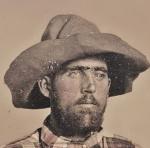
James Buckner ''Buck'' Barry (1821-1906) was a Texas frontiersman who had a dangerous and distinguished career as a Texas Ranger, Indian fighter, scout, sheriff, and rancher. At the time this daguerreotype was made in 1853, Barry was serving as Navarro County treasurer. Source: Lawrence T. Jones III.
From TSHA:
BARRY, JAMES BUCKNER (1821–1906).James Buckner (Buck) Barry, Texas Ranger, was born in North Carolina on December 16, 1821, the son of Bryant Buckner and Mary (Murill) Barry. He immigrated to Texas in 1841 and received a headright grant of 640 acres of land near Corsicana. There he occupied himself, in his own words, with a "little farming and with a great deal of hunting." Barry soon joined theTexas Rangers, first as a member of an independent company at San Antonio and then, from September 15 through December 15, 1845, as a member of Capt. Thomas J. Smith's Robertson County Rangers. Barry then saw service with John Coffee Hays's company. He subsequently went to work surveying headrights in the Robertson district. In 1846 he was elected second sergeant of Capt. Eli Chandler's Company K of Colonel Hays's First Regiment, Texas Mounted Riflemen, for service in the Mexican War. He was wounded at the storming of Monterrey on September 21, 1846, and mustered out of service on October 2, 1846, of that year.
Barry returned to North Carolina, where, on February 24, 1847, he married Sarah Anapolis Matticks. The couple eventually had six children. The family returned to Texas and settled on Bazette Bluff on the Trinity River. For the next ten years Barry was deeply involved in Indian fighting and was especially outspoken as an advocate of the removal of the Comanches and Caddos from their reservations on the upper Brazos River. In 1849 he was elected sheriff of Navarro County and moved to Corsicana. In 1852 he was elected county treasurer and in 1854 was reelected sheriff. In December 1855 he moved his family to Bosque County, where he settled on the East Bosque River east of Meridian. He owned about twenty slaves.
Barry served as a private in Lt. Dixon Walker's Mounted Volunteers in the spring of 1860. In October he raised a company at Meridian that accompanied Lawrence Sullivan Ross into Indian Territory on the expedition responsible for the recapture of Cynthia Ann Parker. During the same period he was the sergeant of Allison Nelson's company of minutemen. On January 10, 1861, Governor Sam Houston issued Barry a commission as first lieutenant with authority to raise a company at Fort Belknap for frontier defense. After secession Barry reenrolled his company into Confederate service in Col. Henry E. McCulloch's regiment and assisted in the removal of federal garrisons from Texas frontier forts. Barry, from his headquarters at Camp Cooper, continued to range the frontier from the Red River to the Rio Grande throughout the Civil War, during which he rose to lieutenant colonel. He also participated in the battle of Dove Creek.
Barry was an active member of the Grange. He was elected in 1883 to the Twelfth Legislature, where he was presented "the finest gun that could be bought" in appreciation of his service in protection of the frontier. He worked in the interest of stock raisers and unsuccessfully sought legislation to outlaw fence-cutting. In 1898 he ran for state treasurer on the People's party ticket but was defeated. He then retired to his ranch near Walnut Springs.
After the death of his first wife in 1862, Barry married Mrs. Martha Anne Peveler Searcy at Fort Belknap, on July 14, 1865. They had three daughters and one son. Barry became blind near the end of his life and died on December 16, 1906.A:
James Buckner ''Buck'' Barry (1821-1906) was a Texas frontiersman who had a dangerous and distinguished career as a Texas Ranger, Indian fighter, scout, sheriff, and rancher. At the time this daguerreotype was made in 1853, Barry was serving as Navarro County treasurer. Source: Lawrence T. Jones III.
From TSHA:
BARRY, JAMES BUCKNER (1821–1906).James Buckner (Buck) Barry, Texas Ranger, was born in North Carolina on December 16, 1821, the son of Bryant Buckner and Mary (Murill) Barry. He immigrated to Texas in 1841 and received a headright grant of 640 acres of land near Corsicana. There he occupied himself, in his own words, with a "little farming and with a great deal of hunting." Barry soon joined theTexas Rangers, first as a member of an independent company at San Antonio and then, from September 15 through December 15, 1845, as a member of Capt. Thomas J. Smith's Robertson County Rangers. Barry then saw service with John Coffee Hays's company. He subsequently went to work surveying headrights in the Robertson district. In 1846 he was elected second sergeant of Capt. Eli Chandler's Company K of Colonel Hays's First Regiment, Texas Mounted Riflemen, for service in the Mexican War. He was wounded at the storming of Monterrey on September 21, 1846, and mustered out of service on October 2, 1846, of that year.
Barry returned to North Carolina, where, on February 24, 1847, he married Sarah Anapolis Matticks. The couple eventually had six children. The family returned to Texas and settled on Bazette Bluff on the Trinity River. For the next ten years Barry was deeply involved in Indian fighting and was especially outspoken as an advocate of the removal of the Comanches and Caddos from their reservations on the upper Brazos River. In 1849 he was elected sheriff of Navarro County and moved to Corsicana. In 1852 he was elected county treasurer and in 1854 was reelected sheriff. In December 1855 he moved his family to Bosque County, where he settled on the East Bosque River east of Meridian. He owned about twenty slaves.
Barry served as a private in Lt. Dixon Walker's Mounted Volunteers in the spring of 1860. In October he raised a company at Meridian that accompanied Lawrence Sullivan Ross into Indian Territory on the expedition responsible for the recapture of Cynthia Ann Parker. During the same period he was the sergeant of Allison Nelson's company of minutemen. On January 10, 1861, Governor Sam Houston issued Barry a commission as first lieutenant with authority to raise a company at Fort Belknap for frontier defense. After secession Barry reenrolled his company into Confederate service in Col. Henry E. McCulloch's regiment and assisted in the removal of federal garrisons from Texas frontier forts. Barry, from his headquarters at Camp Cooper, continued to range the frontier from the Red River to the Rio Grande throughout the Civil War, during which he rose to lieutenant colonel. He also participated in the battle of Dove Creek.
Barry was an active member of the Grange. He was elected in 1883 to the Twelfth Legislature, where he was presented "the finest gun that could be bought" in appreciation of his service in protection of the frontier. He worked in the interest of stock raisers and unsuccessfully sought legislation to outlaw fence-cutting. In 1898 he ran for state treasurer on the People's party ticket but was defeated. He then retired to his ranch near Walnut Springs.
After the death of his first wife in 1862, Barry married Mrs. Martha Anne Peveler Searcy at Fort Belknap, on July 14, 1865. They had three daughters and one son. Barry became blind near the end of his life and died on December 16, 1906.A:
- Attachments
-
- Buckner.jpg (127.58 KiB) Viewed 950 times