Today's entry comes from TSHA:
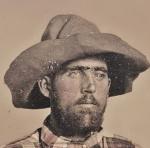
On this day in 1855, Charles Siringo was born in Matagorda County. Beginning in 1870, he worked as a cowboy, part of the time for Shanghai Pierce, and later helped establish the LX Ranch. While working as an LX cowboy, he met Billy the Kid and led a posse into New Mexico in pursuit of him. In 1884, while working as a merchant in Caldwell, Kansas, Siringo began writing his first book, A Texas Cowboy; or, Fifteen Years on the Hurricane Deck of a Spanish Pony (1885), which established him as the first cowboy autobiographer and became a range literature classic. In 1886 he moved to Chicago and began a twenty-two-year career with Pinkerton's National Detective Agency. He subsequently worked all over the West and participated in such celebrated cases as the Haymarket anarchist trial and the murder trial of "Big Bill" Haywood. After leaving Pinkerton's in 1907, Siringo retired to his ranch in Santa Fe, New Mexico. His second book (A Cowboy Detective, 1912) caused a bitter conflict with the Pinkertons, and his Two Evil Isms, Pinkertonism and Anarchism (1915) brought an unsuccessful libel suit from the agency. Siringo was appointed a New Mexico Ranger in 1916 and for two years saw active service against cattle rustlers. Following his return to Santa Fe he published A Lone Star Cowboy (1919) and History of "Billy the Kid" (1920). In 1922 he moved to Los Angeles, where he worked as a film advisor and played bit parts in movies. His Riata and Spurs (1927) was a mature composite of his first two autobiographies. Siringo met such varied celebrities as Pat Garrett, Bat Masterson, Clarence Darrow, William S. Hart, and Will Rogers. He helped to romanticize the West and to create the myth of the American cowboy. Siringo died in California in 1928.
Site seems to be OK. Load issue should be resolved now.
Traces of Tx (today)
-
Shakey Jake
- Drover
- Posts: 4351
- Joined: Wed Aug 16, 2017 11:10 am
- Location: Sugar Land, TX
- Contact:

Re: Traces of Tx (today)
- Attachments
-
- Charles Siringo.jpg (19.38 KiB) Viewed 1274 times
-
Shakey Jake
- Drover
- Posts: 4351
- Joined: Wed Aug 16, 2017 11:10 am
- Location: Sugar Land, TX
- Contact:
Re: Traces of Tx (today)
Per TSHA:
On this day in 1887, "Longhair Jim" Courtright, former town marshall of Fort Worth, was killed in a gunfight with Luke Short. This was one of the most famous gunfights in western history--and, contrary to the movie legends, one of the few face-to-face shootouts. (I posted a couple of years ago here: http://henryrifleforums.com/viewtopic.p ... rt#p174038 )The duel was the first of two events that drew increased hostile attention to the hive of brothels and bars known as Hell's Half Acre. The second was the discovery of a murdered prostitute named Sally, two weeks later. Before these violent occurrences, even legitimate businesses had resisted reform of the Acre because of the money it brought in. But the deaths of Courtright and Sally brought renewed and ultimately successful cleanup efforts.
As the importance of Fort Worth as a crossroads and cowtown grew, so did Hell's Half Acre. It was originally limited to the lower end of Rusk Street (renamed Commerce Street in 1917) but spread out in all directions until by 1881 the Fort Worth Democrat was complaining that it covered 2½ acres. The Acre grew until it sprawled across four of the city's main north-south thoroughfares: Main, Rusk, Calhoun, and Jones. From north to south, it covered that area from Seventh Street down to Fifteenth (or Front) Street. The lower boundary was marked by the Union Station train depot and the northern edge by a vacant lot at the intersection of Main and Seventh. These boundaries, which were never formally recognized, represented the maximum area covered by the Acre, around 1900. Occasionally, the Acre was also referred to as "the bloody Third Ward" after it was designated one of the city's three political wards in 1876.
The Acre meant income for the city-all of it illegal-and excitement for visitors. Possibly for this reason, the reputation of the Acre was sometimes exaggerated by raconteurs; some longtime Fort Worth residents claimed the place was never as wild as its reputation. Suicide was responsible for more deaths than murder, and the chief victims were prostitutes, not gunmen. However much its reputation was exaggerated, the real Acre was bad enough. The newspaper claimed "it was a slow night which did not pan out a cutting or shooting scrape among its male denizens or a morphine experiment by some of its frisky females." The loudest outcries during the periodic clean-up campaigns were against the dance halls, where men and women met, as opposed to the saloons or the gambling parlors, which were virtually all male.
On this day in 1887, "Longhair Jim" Courtright, former town marshall of Fort Worth, was killed in a gunfight with Luke Short. This was one of the most famous gunfights in western history--and, contrary to the movie legends, one of the few face-to-face shootouts. (I posted a couple of years ago here: http://henryrifleforums.com/viewtopic.p ... rt#p174038 )The duel was the first of two events that drew increased hostile attention to the hive of brothels and bars known as Hell's Half Acre. The second was the discovery of a murdered prostitute named Sally, two weeks later. Before these violent occurrences, even legitimate businesses had resisted reform of the Acre because of the money it brought in. But the deaths of Courtright and Sally brought renewed and ultimately successful cleanup efforts.
As the importance of Fort Worth as a crossroads and cowtown grew, so did Hell's Half Acre. It was originally limited to the lower end of Rusk Street (renamed Commerce Street in 1917) but spread out in all directions until by 1881 the Fort Worth Democrat was complaining that it covered 2½ acres. The Acre grew until it sprawled across four of the city's main north-south thoroughfares: Main, Rusk, Calhoun, and Jones. From north to south, it covered that area from Seventh Street down to Fifteenth (or Front) Street. The lower boundary was marked by the Union Station train depot and the northern edge by a vacant lot at the intersection of Main and Seventh. These boundaries, which were never formally recognized, represented the maximum area covered by the Acre, around 1900. Occasionally, the Acre was also referred to as "the bloody Third Ward" after it was designated one of the city's three political wards in 1876.
The Acre meant income for the city-all of it illegal-and excitement for visitors. Possibly for this reason, the reputation of the Acre was sometimes exaggerated by raconteurs; some longtime Fort Worth residents claimed the place was never as wild as its reputation. Suicide was responsible for more deaths than murder, and the chief victims were prostitutes, not gunmen. However much its reputation was exaggerated, the real Acre was bad enough. The newspaper claimed "it was a slow night which did not pan out a cutting or shooting scrape among its male denizens or a morphine experiment by some of its frisky females." The loudest outcries during the periodic clean-up campaigns were against the dance halls, where men and women met, as opposed to the saloons or the gambling parlors, which were virtually all male.
- Attachments
-
- Luke Short.jpg (79.87 KiB) Viewed 1264 times
-
Shakey Jake
- Drover
- Posts: 4351
- Joined: Wed Aug 16, 2017 11:10 am
- Location: Sugar Land, TX
- Contact:
Re: Traces of Tx (today)
Today's entry comes from the Traces of TX Facebook group:
Traces of Texas reader Mary Haner graciously submitted this wonderful photo of the Sayers family outside their home, which comes with a good story Says Mary:
"This is the Sayers home in Dumont. Farley Sayers is 5th from the right. Burke Burnett shot Farley over a cattle dispute May 1912. Farley was married to my Dad's half-sister, Rosa Magee. I remember Dad telling me how proud the young rancher was with his newly built home. Left to right: the carpenter (unknown), Minnie Magee Morgan (Rosa's sister), Walker Morgan (who was in the washroom when Farley got shot), Jess Sayers, Farley Sayers, Little Farley, Rosa Magee Sayers, Lois Sayers, J.T. Sayers and Mary Johnson, who later married Jess Sayers."
The story behind the shooting of Farley Sayers is this: In 1912 when he was 63 years old, Burke Burnett was confronted by Farley Sayers in a bathroom at the Goodland Hotel in Paducah, Texas. Witnesses say Sayers reached for his gun, but was outdrawn by Burnett and killed by a single shot to the chest. Burnett turned himself into local law enforcement and stood trial for murder. Burnett was acquitted on grounds of self defense. A feud between the two men over the ownership of cattle precipitated the event.
Thank you, Mary! I just did quite a bit of research on all of this, to include reading the New York Times account in 1912. I guess any time a man as wealthy as Mr. Burnett ---- owner of the 6666 ranch ------ kills a man, it's newsworthy.
Traces of Texas reader Mary Haner graciously submitted this wonderful photo of the Sayers family outside their home, which comes with a good story Says Mary:
"This is the Sayers home in Dumont. Farley Sayers is 5th from the right. Burke Burnett shot Farley over a cattle dispute May 1912. Farley was married to my Dad's half-sister, Rosa Magee. I remember Dad telling me how proud the young rancher was with his newly built home. Left to right: the carpenter (unknown), Minnie Magee Morgan (Rosa's sister), Walker Morgan (who was in the washroom when Farley got shot), Jess Sayers, Farley Sayers, Little Farley, Rosa Magee Sayers, Lois Sayers, J.T. Sayers and Mary Johnson, who later married Jess Sayers."
The story behind the shooting of Farley Sayers is this: In 1912 when he was 63 years old, Burke Burnett was confronted by Farley Sayers in a bathroom at the Goodland Hotel in Paducah, Texas. Witnesses say Sayers reached for his gun, but was outdrawn by Burnett and killed by a single shot to the chest. Burnett turned himself into local law enforcement and stood trial for murder. Burnett was acquitted on grounds of self defense. A feud between the two men over the ownership of cattle precipitated the event.
Thank you, Mary! I just did quite a bit of research on all of this, to include reading the New York Times account in 1912. I guess any time a man as wealthy as Mr. Burnett ---- owner of the 6666 ranch ------ kills a man, it's newsworthy.
- Attachments
-
- Sayer.jpg (42.38 KiB) Viewed 1252 times
-
Shakey Jake
- Drover
- Posts: 4351
- Joined: Wed Aug 16, 2017 11:10 am
- Location: Sugar Land, TX
- Contact:
Re: Traces of Tx (today)
John Hays, otherwise known as Capt. Jack, was born at Little Cedar Lick, Wilson County, Tennessee. His father Harmon A. Hays fought in the War of 1812, naming his son for a relative by marriage, Colonel John Coffee. In 1836, at the age of 19, Hays migrated to the Republic of Texas. Sam Houston appointed him as a member of a company of Texas Rangers because he knew the Hays family from his Tennessee years. He met with Houston and delivered a letter of recommendation from then-President Andrew Jackson, his great uncle. Rachel Jackson was Hays' great aunt of the Donelson family, a relative of his mother.
In the following years, Hays led the Rangers on a campaign against the Comanche in Texas and succeeded in weakening their power. He rode with a Lipan Chief named Flacco who led the charge into every battle with him. The duo led and inspired the Rangers. In 1840 Tonkawa Chief Placido and 13 scouts joined with the Rangers to track down a large Comanche war party, culminating at the Battle of Plum Creek. The battle of Plum Creek was an aftermath of the Council House Fight, in which many of the Comanche Indian chiefs, women, and warriors were killed. In the summer of 1840, the Comanches swept down the Guadalupe valley, killing settlers, stealing horses, plundering, and burning settlements. After sacking Linnville in Calhoun County, they started a retreat. The Texans organized a volunteer army under Gen. Felix Huston, Col. Edward Burleson, Capt. Mathew Caldwell, and others and with Texas Rangers under Ben McCulloch overtook the Indians at Plum Creek in the vicinity of the present town of Lockhart on August 11, 1840. There a decisive defeat on the following day pushed the Comanches westward.
In 1849 Hays led a wagon train to California during the Gold Rush days and served as Sherriff of San Francisco County for four years. A surveyor by profession, Hays laid out the city of Oakland. He died near Piedmont, California in 1883.
In the following years, Hays led the Rangers on a campaign against the Comanche in Texas and succeeded in weakening their power. He rode with a Lipan Chief named Flacco who led the charge into every battle with him. The duo led and inspired the Rangers. In 1840 Tonkawa Chief Placido and 13 scouts joined with the Rangers to track down a large Comanche war party, culminating at the Battle of Plum Creek. The battle of Plum Creek was an aftermath of the Council House Fight, in which many of the Comanche Indian chiefs, women, and warriors were killed. In the summer of 1840, the Comanches swept down the Guadalupe valley, killing settlers, stealing horses, plundering, and burning settlements. After sacking Linnville in Calhoun County, they started a retreat. The Texans organized a volunteer army under Gen. Felix Huston, Col. Edward Burleson, Capt. Mathew Caldwell, and others and with Texas Rangers under Ben McCulloch overtook the Indians at Plum Creek in the vicinity of the present town of Lockhart on August 11, 1840. There a decisive defeat on the following day pushed the Comanches westward.
In 1849 Hays led a wagon train to California during the Gold Rush days and served as Sherriff of San Francisco County for four years. A surveyor by profession, Hays laid out the city of Oakland. He died near Piedmont, California in 1883.
- Attachments
-
- Capt Jack.jpg (62.97 KiB) Viewed 1243 times
-
Shakey Jake
- Drover
- Posts: 4351
- Joined: Wed Aug 16, 2017 11:10 am
- Location: Sugar Land, TX
- Contact:
Re: Traces of Tx (today)
This picture from the UNT archives was too good to pass up. I don't know the photographer, but this is a fine specimen from the 1880's. Texas Rangers Company D's Camp Leona in Uvalde County, Texas, (left to right) Baz Outlaw, Charles Fusselman, Jim Robinson (horseback), Ira Aten, Walter Jones, Walter Durbin, Calvin Aten, Frank Smith, Frank R. Hughes, Jim King and Ernest Rogers. I was going to post this in the morning but too good to wait.
Baz Outlaw was killed by John Henry Selman on April 5, 1894 during a wild brawl in Tillie Howard's brothel in El Paso. (If you recall a previous thread Selman also killed John Wesley Hardin.)
Baz Outlaw was killed by John Henry Selman on April 5, 1894 during a wild brawl in Tillie Howard's brothel in El Paso. (If you recall a previous thread Selman also killed John Wesley Hardin.)
- Attachments
-
- Tx Rangers.jpg (1.47 MiB) Viewed 1237 times
-
Shakey Jake
- Drover
- Posts: 4351
- Joined: Wed Aug 16, 2017 11:10 am
- Location: Sugar Land, TX
- Contact:
Re: Traces of Tx (today)
Per TSHA:
Walter Moses Burton, Black state senator, was brought to Texas as a slave from North Carolina in 1850 at the age of twenty-one. He belonged to a planter, Thomas Burke Burton, who owned a plantation and several large farms in Fort Bend County. While a slave, Walter Burton was taught how to read and write by his master, a skill that served him well in later years. Thomas Burton sold Walter several large plots of land for $1,900 dollars. This land made the freedman one of the wealthiest and most influential Blacks in Fort Bend County. He became involved in politics as early as 1869, when he was elected sheriff and tax collector of Fort Bend County. He was the first Black sheriff elected to office in Texas and the first Black elected sheriff in the country. Along with these duties, he also served as the president of the Fort Bend County Union League. He later served four terms in the state legislature.
More information can be found here:
https://www.tshaonline.org/handbook/ent ... lter-moses
Walter Moses Burton, Black state senator, was brought to Texas as a slave from North Carolina in 1850 at the age of twenty-one. He belonged to a planter, Thomas Burke Burton, who owned a plantation and several large farms in Fort Bend County. While a slave, Walter Burton was taught how to read and write by his master, a skill that served him well in later years. Thomas Burton sold Walter several large plots of land for $1,900 dollars. This land made the freedman one of the wealthiest and most influential Blacks in Fort Bend County. He became involved in politics as early as 1869, when he was elected sheriff and tax collector of Fort Bend County. He was the first Black sheriff elected to office in Texas and the first Black elected sheriff in the country. Along with these duties, he also served as the president of the Fort Bend County Union League. He later served four terms in the state legislature.
More information can be found here:
https://www.tshaonline.org/handbook/ent ... lter-moses
- Attachments
-
- RBurton.jpg (168.93 KiB) Viewed 1224 times
-
- Burton.jpg (18.21 KiB) Viewed 1224 times
-
Shakey Jake
- Drover
- Posts: 4351
- Joined: Wed Aug 16, 2017 11:10 am
- Location: Sugar Land, TX
- Contact:
Re: Traces of Tx (today)
Here's another fine picture from the W.D. Smith Collection. Texas Rangers at Judge Roy Bean's Jersey Lilly saloon and Justice of the Peace court in Langtry, Texas, Pecos County 1880's.
- Attachments
-
- Jersey Lilly.jpg (1.05 MiB) Viewed 1223 times
-
Shakey Jake
- Drover
- Posts: 4351
- Joined: Wed Aug 16, 2017 11:10 am
- Location: Sugar Land, TX
- Contact:
Re: Traces of Tx (today)
Oh, my came across this picture taken in 1953 of "Rockyfeller's" in Fort Worth, TX. I remember my mom buying 19¢ hamburgers at Griff's in Joplin, Missouri along with 5¢ cokes and 10¢ fries when a kid in the 60's, but a hamburger for 5¢! I bet they were delicious as well. It makes me want to go out and get one for lunch!
- Attachments
-
- Rockyfeller.jpg (187.36 KiB) Viewed 1220 times
-
Shakey Jake
- Drover
- Posts: 4351
- Joined: Wed Aug 16, 2017 11:10 am
- Location: Sugar Land, TX
- Contact:
Re: Traces of Tx (today)
Here's another great picture of the Jersey Lily with Judge Roy Bean himself in front of the establishment. Here's a snippet of information from TSHA:
By 1884 Bean was settled at Eagle's Nest Springs, some miles west of Vinegarroon, which acquired a post office and a new name, Langtry. Bean claimed credit for naming the town after English actress Emilie Charlotte (Lillie) Langtry, whom he greatly admired. Actually, railroad records indicate that the town was named for George Langtry, a railroad construction foreman. Bean's fame as a bizarre interpreter of the law began in the 1880s. There was, however, a sort of common sense behind his unorthodox rulings. When a track worker killed a Chinese laborer, for example, Bean ruled that his law book did not make it illegal to kill a Chinese. Since the killer's friends were present and ready to riot, he had little choice. And when a man carrying forty dollars and a pistol fell off a bridge, Bean fined the corpse forty dollars for carrying a concealed weapon, thereby providing funeral expenses. He intimidated and cheated people, but he never hanged anybody. He reached the peak of notoriety on February 21, 1896, when he staged the Fitzsimmons-Maher heavyweight championship fight on a sandbar just below Langtry on the Mexican side of the Rio Grande, where Woodford H. Mabry's rangers, sent to stop it, had no jurisdiction. Fitzsimmons won in less than two minutes.
The full article can be found here: https://www.tshaonline.org/handbook/entries/bean-roy
By 1884 Bean was settled at Eagle's Nest Springs, some miles west of Vinegarroon, which acquired a post office and a new name, Langtry. Bean claimed credit for naming the town after English actress Emilie Charlotte (Lillie) Langtry, whom he greatly admired. Actually, railroad records indicate that the town was named for George Langtry, a railroad construction foreman. Bean's fame as a bizarre interpreter of the law began in the 1880s. There was, however, a sort of common sense behind his unorthodox rulings. When a track worker killed a Chinese laborer, for example, Bean ruled that his law book did not make it illegal to kill a Chinese. Since the killer's friends were present and ready to riot, he had little choice. And when a man carrying forty dollars and a pistol fell off a bridge, Bean fined the corpse forty dollars for carrying a concealed weapon, thereby providing funeral expenses. He intimidated and cheated people, but he never hanged anybody. He reached the peak of notoriety on February 21, 1896, when he staged the Fitzsimmons-Maher heavyweight championship fight on a sandbar just below Langtry on the Mexican side of the Rio Grande, where Woodford H. Mabry's rangers, sent to stop it, had no jurisdiction. Fitzsimmons won in less than two minutes.
The full article can be found here: https://www.tshaonline.org/handbook/entries/bean-roy
- Attachments
-
- Judge Bean.jpg (1.12 MiB) Viewed 1202 times
-
Shakey Jake
- Drover
- Posts: 4351
- Joined: Wed Aug 16, 2017 11:10 am
- Location: Sugar Land, TX
- Contact:
Re: Traces of Tx (today)
I've got a busy morning so just posting another great picture. This one is also from the UNT digital library of some Texas Rangers near Marfa, Tx. I had a good friend and classmate from TCU that was a band director in Marfa for a number of years. Here's a snippet of information from TSHA. More information can be found here: https://www.tshaonline.org/handbook/entries/marfa-tx
The town's biggest attraction, however, is the famous Marfa Lights. The town and surrounding area have also provided the background for several Hollywood movies, including Giant (1956), the Andromeda Strain (1971), There Will Be Blood (2007), and No Country for Old Men (2007). The 1960 population of 2,799 had decreased to 2,647 by 1970. That year Marfa had several small local industries among its seventy-nine reported businesses. The 2,466 inhabitants of Marfa celebrated the town's 100th birthday on March 5, 6, and 7, 1983. For the celebration about 5,000 friends, relatives, and former Marfans came to have a memorable time and enjoy their city. In 1990 Marfa reported a population of 2,424. That figure decreased to 2,121 in 2000 and 1,981 in 2010.
The town's biggest attraction, however, is the famous Marfa Lights. The town and surrounding area have also provided the background for several Hollywood movies, including Giant (1956), the Andromeda Strain (1971), There Will Be Blood (2007), and No Country for Old Men (2007). The 1960 population of 2,799 had decreased to 2,647 by 1970. That year Marfa had several small local industries among its seventy-nine reported businesses. The 2,466 inhabitants of Marfa celebrated the town's 100th birthday on March 5, 6, and 7, 1983. For the celebration about 5,000 friends, relatives, and former Marfans came to have a memorable time and enjoy their city. In 1990 Marfa reported a population of 2,424. That figure decreased to 2,121 in 2000 and 1,981 in 2010.
- Attachments
-
- Tx Rangers Marfa.jpg (1.16 MiB) Viewed 1189 times

Re: Traces of Tx (today)
In Spokane there is a place called Dick’s Hamburgers and when I was a kid I remember the sign said .21 cents and their slogan is, “buy the bag full”. Once in a while our dad would head down there and bring home a bag full along with fries and shakes. Now that was a treat. They still use a potato press to make the fries and they are still considered the best fast food fries in the area.Shakey Jake wrote: ↑Sat Feb 11, 2023 1:08 pmOh, my came across this picture taken in 1953 of "Rockyfeller's" in Fort Worth, TX. I remember my mom buying 19¢ hamburgers at Griff's in Joplin, Missouri along with 5¢ cokes and 10¢ fries when a kid in the 60's, but a hamburger for 5¢! I bet they were delicious as well. It makes me want to go out and get one for lunch!
-
Shakey Jake
- Drover
- Posts: 4351
- Joined: Wed Aug 16, 2017 11:10 am
- Location: Sugar Land, TX
- Contact:
Re: Traces of Tx (today)
I'm finding quite a few pictures of Texas Rangers on the UTA digital library. This one is dated 1892. I do believe I see at least one Henry in the picture.
Title: Texas Rangers, Company E, Frontier Battalion
Creator: Smith, W. D. (Photographer)
Description: Caption reads: "Company E, Texas Rangers, Frontier Battalion, Alice, Texas, 1892. -- #1 Capt. J.S. McNeel; #2 D.S. Robinson; #3 John Cameron; #4 Charles Johnson; #5 Luke Dowe; #6 P.J. McNeel (not a ranger); #7 Rigdon "Fat" Terrell; #8 Forest Townsley; #9 J.S. McNeel, Jr; #10 Everett E. Townsend; #11 Richard Flowers, (not a ranger); #12 Charles Premont; #13 Bud Rader; #14 Louis Pauli; #15 Rut Evans; #16 Bob Townsley."
Date Created: 1892
Title: Texas Rangers, Company E, Frontier Battalion
Creator: Smith, W. D. (Photographer)
Description: Caption reads: "Company E, Texas Rangers, Frontier Battalion, Alice, Texas, 1892. -- #1 Capt. J.S. McNeel; #2 D.S. Robinson; #3 John Cameron; #4 Charles Johnson; #5 Luke Dowe; #6 P.J. McNeel (not a ranger); #7 Rigdon "Fat" Terrell; #8 Forest Townsley; #9 J.S. McNeel, Jr; #10 Everett E. Townsend; #11 Richard Flowers, (not a ranger); #12 Charles Premont; #13 Bud Rader; #14 Louis Pauli; #15 Rut Evans; #16 Bob Townsley."
Date Created: 1892
- Attachments
-
- 20109943.jpg (857.95 KiB) Viewed 1042 times
-
Shakey Jake
- Drover
- Posts: 4351
- Joined: Wed Aug 16, 2017 11:10 am
- Location: Sugar Land, TX
- Contact:
Re: Traces of Tx (today)
There's a small place in Texas called Honey Island. Honey Island is at the junction of Farm roads 1003 and 1293, thirty-five miles northwest of Beaumont in central Hardin County. It is on high land between Cypress and Flat Cypress creeks, which rise in heavy rain, making the site a temporary island. Back during the civil war Jayhawkers, Confederate deserters, and those who opposed succession hid out in the area. Being hard pressed for food the band would take honey from the numerous hives in the area and leave it on the "island" for locals to exchange it for food. Although their numbers were only estimated to be between 15 and 20 Captain Bullock of the Confederate militia decided to capture the "Union sympathizers". The area became known as Union Wells due to the camouflaged diggings used as a water source during dry weather. It was during one of these dry spells that Bullock decided to burn out the band of "Unionists" although they were a peaceable lot. The area was a dense thicket of woods and canebrake and when set afire in a horseshoe shape to capture the band on the "island" they only captured a few and only two were killed. One of those killed wasn't even a part of the band. He was known as "Old Man Lilly" and was killed while on his way home with a deer he had shot. It was said he was shot right through the heart. The skirmish, if you could even call it that, was named the Battle of Bad Luck Creek due to Lilly's "accidental death". Other's call it "Kaiser's Burnout" after a German settler in the area.
- Attachments
-
- Honey Island.jpg (457.86 KiB) Viewed 1029 times
-
Shakey Jake
- Drover
- Posts: 4351
- Joined: Wed Aug 16, 2017 11:10 am
- Location: Sugar Land, TX
- Contact:
Re: Traces of Tx (today)
On this day in 1914, the body of South Texas rancher Clemente Vergara was found hanging from a tree. Vergara owned a ranch near Palafox. He allowed his horses to graze on an island in the Rio Grande, land that was disputed by the United States and Mexico. Vergara suspected that Mexican soldiers had stolen eleven of his horses from the island. He and a nephew crossed the Rio Grande to meet with several soldiers who called the two men over. Vergara was struck on the head and carried to the Hidalgo garrison, while his nephew escaped and returned to the United States. Vergara's wife and daughter crossed into Mexico on February 14 and found him severely beaten and jailed in the Hidalgo garrison. The following morning soldiers told the women that he had been taken to Piedras Negras. Texas governor Oscar B. Colquitt and President Woodrow Wilson's administration disagreed on how to deal with the situation, with the former advocating the use of Texas Rangers to extradite Vergara's kidnappers if necessary. On February 16 the commander at Piedras Negras reported that he had ordered Vergara's release and the return of his horses; however, on February 25 witnesses told American officials that they had seen Vergara's body hanging from a tree near Hidalgo, and that it had been there since February 15. Vergara's body was finally "delivered" to his relatives in Texas on March 7. Vergara's murder outraged Texans and increased tension between Mexico and the United States.
More on Palafox:
The Palafox, Burkeville, Sabine and Rio Grande Railroad, chartered in 1854, was never built. In the 1880s there were two large stores, the Cantú and Alexander stores, at the site; a post office operated from 1886 to 1887 and again from 1905 to 1922. A map drawn by William Sydney Porter in 1888 shows Palafox with no roads leading to it and no adjoining settlements. The 1910 census listed forty inhabitants. Jack Walker, the settlement's last inhabitant, left in 1938. Ruins of numerous stone buildings, a cemetery, and an irrigation system built in the 1920s remained in 1990.
More on Palafox:
The Palafox, Burkeville, Sabine and Rio Grande Railroad, chartered in 1854, was never built. In the 1880s there were two large stores, the Cantú and Alexander stores, at the site; a post office operated from 1886 to 1887 and again from 1905 to 1922. A map drawn by William Sydney Porter in 1888 shows Palafox with no roads leading to it and no adjoining settlements. The 1910 census listed forty inhabitants. Jack Walker, the settlement's last inhabitant, left in 1938. Ruins of numerous stone buildings, a cemetery, and an irrigation system built in the 1920s remained in 1990.
-
Shakey Jake
- Drover
- Posts: 4351
- Joined: Wed Aug 16, 2017 11:10 am
- Location: Sugar Land, TX
- Contact:
Re: Traces of Tx (today)
I found this interesting picture on the UTSA library digital site. It's titled "Party at Shady Oak Farm in celebration of the premiere of the 1940 film, "The Westerner," in Fort Worth, Texas." The Shady Oak Farm was owned by Amon G. Carter. Carter was the owner of the Fort Worth Star-Telegram and WBAP radio and television. He was very influential in Ft. Worth:
https://www.tshaonline.org/handbook/ent ... -amon-g-sr
The "Howdy Stranger" bar was part of the Shady Oak Farm and a gathering place for celebrities visiting Fort Worth. "The Westerner" (per IBID) Judge Roy Bean, a self-appointed hanging judge in Vinegarroon, Texas, befriends saddle tramp Cole Harden, who opposes Bean's policy against homesteaders.
It starred Walter Brennan, Gary Cooper and Doris Davenport along with other notable actors of the time. There was a TV show with the same name in the 60's starring Brian Keith. I remember watching it as a kid. I think you might spot a star or two in this picture.
https://www.tshaonline.org/handbook/ent ... -amon-g-sr
The "Howdy Stranger" bar was part of the Shady Oak Farm and a gathering place for celebrities visiting Fort Worth. "The Westerner" (per IBID) Judge Roy Bean, a self-appointed hanging judge in Vinegarroon, Texas, befriends saddle tramp Cole Harden, who opposes Bean's policy against homesteaders.
It starred Walter Brennan, Gary Cooper and Doris Davenport along with other notable actors of the time. There was a TV show with the same name in the 60's starring Brian Keith. I remember watching it as a kid. I think you might spot a star or two in this picture.
- Attachments
-
- HOWDY.jpg (2.12 MiB) Viewed 1007 times
-
Shakey Jake
- Drover
- Posts: 4351
- Joined: Wed Aug 16, 2017 11:10 am
- Location: Sugar Land, TX
- Contact:
Re: Traces of Tx (today)
Photograph of the Guadalupe Peak. The peak is a part of the Guadalupe Mountains National Park which ranges from West Texas to southeastern New Mexico. Guadalupe Peak, also known as Signal Peak, is the highest point in Texas. It is in Guadalupe Mountains National Park three miles west of Pine Springs in northwestern Culberson County (at 31°53' N, 104°52' W). Its summit, with an elevation of 8,749 feet above sea level, rises 3,100 feet above Pine Springs. The peak towers over nearby Guadalupe Pass, and nineteenth-century travelers, including John Russell Bartlett, were often deceived by the peak's great height and the clear mountain air; they reported seeing the peak a full week before they reached it and consistently underestimated their distance from it.
- Attachments
-
- Guadelupe Peak.jpg (217.84 KiB) Viewed 994 times
-
Shakey Jake
- Drover
- Posts: 4351
- Joined: Wed Aug 16, 2017 11:10 am
- Location: Sugar Land, TX
- Contact:
Re: Traces of Tx (today)
On this day in 1943, Dolly Shea graduated with the first flight-nurse class of the United States Army Air Forces at Bowman Field, Kentucky. The San Benito, Texas, native served in the European Theater during World War II. She was killed on April 14, 1945, when her evacuation plane, ferrying wounded Americans to hospitals behind the front line, was shot down over Germany. She was one of three women in the Army Nurse Corps known to have been killed by direct enemy action and the only one from Texas. Her awards include the Air Medal, the Red Cross Medal, a Special Citation from President Harry Truman, and a posthumous Purple Heart.
- Attachments
-
- Dolly Vinsant.jpg (17.52 KiB) Viewed 986 times
-
Shakey Jake
- Drover
- Posts: 4351
- Joined: Wed Aug 16, 2017 11:10 am
- Location: Sugar Land, TX
- Contact:
Re: Traces of Tx (today)
Another fine picture from the UTA digital library. This one entitled "Childress, Texas in 1897, wagons being loaded for a trip to Matador. Windmill watering trough with men, horses, and wagons clustered about it, town stores in background". It's a 58 mile trip today. I'm not sure if they would have taken the same route.
The Matador Ranch was consolidated in 1882 by a Scottish syndicate, and a post office opened at Matador in 1886. At the end of the 19th century, townspeople freed the community from domination by the Matador Ranch, which was liquidated in 1951, by relocating non-ranch families there and electing their own slate of officials. The community was incorporated in 1912 and made the county seat. The state required that a town have at least 20 businesses. Local ranch hands hence established fraudulent, temporary businesses using ranch supplies. The only real business in Matador at the time was a saloon.
The Matador Ranch was consolidated in 1882 by a Scottish syndicate, and a post office opened at Matador in 1886. At the end of the 19th century, townspeople freed the community from domination by the Matador Ranch, which was liquidated in 1951, by relocating non-ranch families there and electing their own slate of officials. The community was incorporated in 1912 and made the county seat. The state required that a town have at least 20 businesses. Local ranch hands hence established fraudulent, temporary businesses using ranch supplies. The only real business in Matador at the time was a saloon.
- Attachments
-
- 10000052.jpg (1.03 MiB) Viewed 986 times
-
Shakey Jake
- Drover
- Posts: 4351
- Joined: Wed Aug 16, 2017 11:10 am
- Location: Sugar Land, TX
- Contact:
Re: Traces of Tx (today)
Here's another picture of the Howdy Stranger bar. The sign in the background says " Welcome, Fort Worth, where the West begins and the East peters out."
- Attachments
-
- 20105200.jpg (2.3 MiB) Viewed 984 times
-
Shakey Jake
- Drover
- Posts: 4351
- Joined: Wed Aug 16, 2017 11:10 am
- Location: Sugar Land, TX
- Contact:
Re: Traces of Tx (today)
On this day in 1838, captive Rachel Plummer was reunited with her husband after spending over a year with the Comanches. Born Rachel Parker in Illinois in 1819, she moved to Texas with her father, James W. Parker, and her family and married Luther Plummer in 1833. In May 1836 their settlement was attacked by a large group of Indians. Five settlers were taken captive: Rachel and her son James Pratt Plummer, Cynthia Ann and John Parker, and Elizabeth Kellogg. James Pratt was taken from Rachel, and she never saw him again. Rachel became a slave to the Comanches, and traveled thousands of miles with the band. She was pregnant at the time of her capture and bore a second son about October 1836. The Indians thought that the baby was interfering with Rachel's work, so they killed him when he was about six weeks old. Rachel was ransomed by Mexican traders north of Santa Fe in June 1837. Several months later, Rachel's brother-in-law escorted her back to Texas, where she was reunited with her husband. In 1838 she published an account of her captivity entitled Rachael Plummer's Narrative of Twenty One Months Servitude as a Prisoner Among the Commanchee Indians. This was the first narrative about a captive of Texas Indians published in Texas. Rachel bore a third child in 1839 and died in Houston shortly thereafter; the child died two days later.